30 July 2017

2017 Update

It's 2017 and I'm reading some of my old posts thinking, "I was way-off base with my predictions and beliefs."

One of the key concepts I've learned in the past 2 years is the futility of predictions. Nobody can predict with any accuracy more than a year into the future. The system is too complex (good YouTube series on complex systems here). I made a page about failed economist predictions that I haven't updated with the outcome but you can see for yourself what they were thinking and how wrong they were.

Rather than go into a long blog post about why and how predictions fail, I'll direct you to a book that summarises the evidence better than I can. That book is Superforecasting by Philip Tetlock and Dan Gardner. I encourage anyone who is interested in predictions to give it a read.

Another key understanding that has become stronger in the last few years is letting go of strong ideological beliefs and particularly beliefs that are part of your identity. These beliefs will make it very difficult to view evidence and information on its merits without confirmation bias coming into play. I wrote an article in late 2014 about this very concept and I think it is very beneficial to any critical thinkers.

The blog going forward

I don't intend to write detailed blog posts simply because most information is already out there on the internet and I would just be rehashing it with my own interpretation.

I will be posting random blog posts about things I want to document and share publicly for entertainment and general interest purposes. I think the next blog post will be a list of finance and trading movies that I've watched.


As always I can be contacted on twitter: @ShervinD

23 August 2015

Abenomics

This post will look at Japan's recent economic performance under the policy of Abenomics. Policy recommendations are made at the end.

Japan's Prime Minster, Shinzo Abe

In 2012 Japan's prime minister, Shinzo Abe, ushered in a new set of economic policies which have been termed Abenomics. The policy involves "three arrows": fiscal policy, monetary policy and structural reform.

For further in depth analysis and details on Abenomics please read: Abenomics and the Japanese Economy.

Japan's recent performance

The latest GDP print is disappointing; Japan's economy shrank 1,6% (annualised) in the last quarter. Exports where down 16.5% (annualised) highlighting the flaws the export reliant model. When global growth or export markets slow, the export economy suffers.1

Private consumption fell 3% (annualised), which is significant given Japan's economy is 60% consumption. The falling Yen added to problems for the Japanese consumer with food prices rising.1


The large drop in growth seen in 2014 (see above chart) was the result of an increase in the consumption tax from 5% to 8%. 

Is Abenomics a success?

The rise in the consumption tax hurt consumer spending at at time the economy didn't need it. The result was a recession in late 2014 (two quarters of negative economic growth). Increasing government spending while increasing taxes is like having one foot on the accelerator and the other on the brake. The government must focus on generating growth today and address fiscal sustainability in a few years or expect the jittery economic growth to continue.

Raising domestic demand is paramount and the government should not only cancel future consumption tax increases but also reverse the previous increase. Additionally, the government could lower taxes for low-income earners to increase disposable income. It must be noted that Japan's income tax is very progressive.

Relying on a currency devaluation to boost exports is a less effective tool to boost growth. Firstly, the gains are marginal given the increasingly global supply chain. Secondly, it acts as a consumption tax on imports which reduces household real incomes. As mentioned above, rising food costs have become a problem for Japan.

The demographic challenge Japan faces must be addressed either through higher birth rates or net migration and getting more women into the workforce. This is one of the major aims of the structural reforms proposed under Abenomics.

Conclusion

The failure of Abenomics is political (not economic) with the deficit hawks continually demanding policies to reduce the deficit when the exact opposite is needed to propel Japan out of its protracted economic malaise. The more difficult task will be establishing the structural reforms which challenge the politically strong vested interests. If Japan can overcome these hurdles, they will be the shining example of an economy that escaped the debt deflation global epidemic.


References

  1. Warnock, E. and Obe, M. (2015). Japan’s Economy Shrinks in Second Quarter. [online] WSJ. Available at: http://www.wsj.com/articles/japans-economy-shrinks-annualized-1-6-in-second-quarter-1439769883 [Accessed 23 Aug. 2015].

16 August 2015

Austrian Malinvestment Theory

A new train station in Wuhan (Central China) completed at the end of 2009

While a lot of what the Austrian School of Economics says is just political theory dressed up as economics, some of their theories may be sound in the real world. One such theory is the theory of malinvestment.

Malinvestment is a mistaken investment in the wrong line of production, which inevitably leads to wasted capital and economic loss, subsequently requiring a reallocation of resources to more productive uses.1

The theory of malinvestment is a critical part of the business cycle according to the Austrian school. They blame the government either through its spending decisions or through the central bank for causing these market distortions resulting in misallocation of resources and the malinvestments which inevitably have to be liquidated.

To the neutral observer, one may be quick to dismiss this as the standard Libertarian anti-government rhetoric. However, it is widely accepted that poor central planning can lead to massive investments that are proven to be unproductive and misaligned with consumer demand.

This blog post follows the post on Minsky's Financial Instability Hyporthesis and tries to explain the business cycle phenomenon. The question is whether the government, the central bank and the fractional reserve system are the cause of the bad investments or is it more along the lines of Minsky's FIH - that the boom-busy process is inherent to a capitalist economy. I believe that both can be correct. The private and public sector are prone to making bad decisions. The government's decisions have greater economic impact but the private sector can also generate asset bubbles that can have greater consequences than any government decision ever could.

Krugman's Criticisms of Malinvestment Theory

Paul Krugman describes this as "Hangover Theory". He first states that investment cycles should not be assumed to correlate with the economic cycle. He makes the point that any reduction of investment will result in an increase in consumption because someone's spending is another's income. He also points out that every industry feels the pain, not just the investment sector.2

Krugman then states "A recession happens when, for whatever reason, a large part of the private sector tries to increase its cash reserves at the same time." He then suggests an increase in the money supply after the private sector writes off its bad investments because after the write off, there is only idle productive capacity left.2

Krugman attributes the appeal of "Hangover Theory" to counter the perceived statist implications of Keynesianism and describes the theory as "intellectually incoherent."2

Examples of malinvestment

The clearest examples of malinvestment are those government projects that cost billions and eventually prove to be white elephants because the economic and social benefits are tiny compared to the cost of the project. However, the worst malinvestments occur when the private sector AND the government work together to create gargantuan investment and asset bubbles.

A great example is the property and construction boom in China. After 2008, the Chinese government instructed its banks to lend and finance the construction sector. We saw the creation of ghost cities and the demand for iron ore (used to create the steel needed to build) sky-rocket. The Austrians would describe this as a false price signal, which caused iron ore miners around the world to increase their production capacity. Australia was one of the chief beneficiaries with mining investment driving much of the economic growth seen post-2008. In the last year or two, we have seen the Chinese economy roll over and with that the price of all commodities. The demand for steel has plummeted and the iron ore price has crashed. Just a few days ago BHP announced its third round of job cuts which reflects the adjustment to the overcapacity now laid bare in the mining sector.

Other examples from history include the US housing bubble. Interest rates reached 1% in 2002-2003 before slowly rising. Government policies encouraged and supported lending to sub-prime individuals through mandates and GSEs like Fannie Mae and Freddie Mac. Of course there was also widespread fraud on the part of the private sector. But the question remains, if interest rates bottomed at 2% instead of 1%, would the fallout have been far more limited?

Conclusion

One should be cautious when reading anything from the Austrian school, simply because of the political bias that is the foundation of their economic thought process. If an objective observer sees government intervention in an economy leading to investment booms and later a bust, it would be apt to fault the original government decision. It must be said that the government is not the only one making bad investment decisions. The private sector does it all the time and as Minksy's theory postulates, it may be inherent to a capitalist economy. Both theories importantly point out that the private sector makes mistakes, which many mainstream economic models seem to ignore.

References

  1. Wiki.mises.org, (2015). Malinvestment - Mises Wiki, the global repository of classical-liberal thought. [online] Available at: https://wiki.mises.org/wiki/Malinvestment [Accessed 16 Aug. 2015].
  2. Krugman, P. (2015). The Hangover Theory. [online] Slate Magazine. Available at: http://www.slate.com/articles/business/the_dismal_science/1998/12/the_hangover_theory.single.html [Accessed 16 Aug. 2015].

25 May 2015

Minsky's Financial Instability Hypothesis

Ponzi finance is like an unstable house of cards

The boom-bust cycle in economics is one which has many explanations. The Austrians blame malinvestments caused by central banks setting interest rates too low, Keynes blamed animal spirits and Marx warned it was falling profits that caused the bust. An increasingly popular explanation for the boom-bust cycle is the Financial Instability Hypothesis proposed by Hyman Minsky. The theory suggests that the rising proportion of debt relative to cash flow causes financial instability. This phenomena is inherent to a market economy and it is often summarised as "stability breeding instability."

I think there are some similarities with the Austrian malinvestment theory which I'll be covering in a future blog post.

This blog post is mostly a summary of journal articles from the Levy institute which are references at the end.

What is the Financial Instability Hypothesis?

The hypothesis refers to phases in which economic units go through as the economic cycle develops.

There are three phases that economic units can involve themselves in:

  • Hedge financing occurs when units can fulfil all of their contractual payment obligations by their cash flows. The more equity in the liability structure, the more likely they are a hedge financing unit.
  • Speculative finance units can meet their payment commitments on their liabilities, even though they cannot pay back principal from income cash flows. Such units will "roll over" their liabilities.
  • Ponzi finance units' cash flow from operations are not sufficient to fulfil either the repayment of principal or interest on outstanding debts. Such units can sell assets or borrow. Borrowing to pay interest lowers their equity. A unit that Ponzi finances, lowers the margin of safety that it offers the holders of its debt.

If hedge financing dominates, the economy is stable. In contrast, the greater the weight of speculative and Ponzi finance, the greater the likelihood the economy is in a deviation amplifying system (simply put, a big boom or bust).

Financial Instability Hypothesis Theorems

  1. The first theorem of the Financial Instability Hyphothesis (FIH), the economy has financing regimes under which it is stable and regimes in which it is unstable. 
  2. The second theorem is that over long periods of prosperity, the economy transitions from a stable financial system to an unstable system. Capitalist economies transit from hedge financing units to a structure in which there is a large weight of speculative and Ponzi finance.
If the economy is in an inflationary state and monetary policy tightens, speculative finance units will become Ponzi finance units and previously Ponzi finance units will see their net worth decline. These units will have to sell assets and thus asset values decline.

The FIH model does not rely on exogenous shocks to generate business cycles of various severity. The hypothesis holds that the business cycles of history are compounded by internal dynamics of a capitalist economy and the system of interventions and regulations that are designed to keep the economy operating within a reasonable bound.

Link to behavioural economics?

The paradigm shift away from assuming we are rational economic units to accepting the real world proof of the opposite, is a recent occurrence. Minksy refers to the "euphoric economy" which can be linked to biases such as the overconfidence bias and the herd mentality. There is no doubt that these traits exacerbate the bubbles and provide a fertile ground for speculative and Ponzi finance to emerge.

Other important notes from Tymoigne (2010)

  • Government deficits directly improve the financial strength of the private sector.
  • Government deficit may be a problem if there's a stringent exchange rate regime (e.g. Greece - monetary sovereignty surrendered to the Eurozone) or if debt is issued in foreign currency (e.g. Argentina)
  • Financial fragility is not a measure of the size of the leverage but the quality
  • Bell (2009) found good indicators of banking crises include rapid loan growth, slow output growth, and rising real interest rates.
  • Speculative and Ponzi finance haver a higher mismatch between assets and liabilities, which most of the time means that there is a high proportion of short-term debts and low liquidity buffers. 
  • Under Ponzi finance, it is expected that net worth and liquidity will decrease given asset values. This decline in net worth and liquidity will not be recorded in data until defensive position-making needs actually occur. If assets are valued on a market basis, and if their prices grow fast enough to compensate for higher debt or lower liquid assets, the decline in net worth can be avoided (Minksy 1964: 213ff.) In that case, the growing solvency of economy unit involved in a Ponzi process depends highly on the continuation of rising assets, rather than on the capacity to generate an income from the ownership of the asset. In fact, an economic unit involved in Ponzi finance is guaranteed to record very high short-term profits and so a very high increase in net worth for a short period.

Where are we now?

A few examples in recent weeks of Ponzi finance come from the China/commodity boom.

The most obvious economy in the Ponzi finance phase is China. Just read this: (oringal here: http://english.caixin.com/2015-03-11/100790192.html)

"In years past, Rongsheng found it easy to get bank support for building orders. But according to a ship financing expert, banks changed their tune after Rongsheng started having trouble repaying loans. The repayment woes surfaced after the company apparently overstretched its order books to the point where it couldn't deliver vessels on time.
Rongsheng's weak financial position was highlighted by a third-quarter 2014 financial report in which the company posted a net loss of 2.4 billion yuan. It also reported 31.3 billion yuan in liabilities, including 7.6 billion yuan worth of outstanding short-term debt.
A source close to the company said Rongsheng's capital crunch has worsened since February 2014, when the CDB demanded more collateral after the company failed to make a scheduled payment on a 710 million yuan loan. When Rongsheng refused, the CDB called the loan. Other banks that issued loans to the shipbuilder have taken similar steps, said the source."


Just the other day another example of Ponzi finance came to light when Fortescue (ASX: FMG) tried to refinance their debt only to change the structure and then cancel the transaction. (original here: http://www.abc.net.au/news/2015-03-18/fortescue-debt-debacle-highlights-perilous-position/6328668 )

That initial deal was for a $US2.5 billion syndicated loan. It was scrapped yesterday in favour of the "Senior Secured Note Offering" which also has been junked in what can only be interpreted as a worrying development for the nation's third biggest iron ore exporter.

This sums up the situation well:


It is clear that FMG can no longer payback the principal and is in the speculative finance stage. As the price of iron ore falls below the cost of production, Fortescue is no longer profitable. At this stage paying interest becomes a problem as cash reserves drain and Fortescue enters the Ponzi finance stage. As long as iron ore prices continue to fall, Fortescue is guaranteed to become a Ponzi finance unit.

I have been a China bear for a few years now (see last year's detailed post here) and it looks like the wheels are finally coming off.

Conclusion

Minsky's FIH is an important theory for understanding how an economy can become unstable due to the debt financing decisions of economic units. It is a theory that should stand the test of time as most recessions and financial crises involve economic units that end up financing low quality investments. Recessions could be mitigated if  policy makers monitor the quality of investments and take action before the financial system becomes extremely fragile.

References:

Minksy, Hyman P. 1992. Financial Instability Hypothesis. http://www.levyinstitute.org/pubs/wp74.pdf

Tymoigne, Eric. 2010. Detecting Ponzi Finance: An Evolutionary Approach to the Measure of Financial Fragility http://www.levyinstitute.org/pubs/wp_605.pdf

04 December 2014

Economics and Politics

Source: Lena Groeger

One of the most important fields to emerge in the past three decades is the field of cognitive and behavioural bias. Countless experiments prove that we are all heavily biased decision makers and not the rational homo economicus purported by academic theories. Because economics is not a natural science like physics, conducting experiments to prove theories is not possible. Despite this, economists have tried to use maths (see econometrics) to prove various theories. The problem with constructing mathematical models is the reliance on assumptions and because there are so many moving parts in the economy, even a complex model will be inaccurate.

The lack of clear evidence results in multiple theories that are difficult to disprove. Usually supporters of a particular economic theory will find it magically aligns with their political bias. Obviously this is no surprise because confirmation bias is one of the most common biases we all exhibit.


For economics to really become practical and more scientific, biases must be eradicated when conducting economic analysis. When biases are mitigated, you don't get flawed predictions like "QE will result in hyperinflation" or "the budget sequester will cause the economy to go into recession."

For economics to be scientific and void of bias, it must be apolitical. I can only hope that one day economics will be apolitical. What will this day look like? It will occur when the vast majority of the economists agree on theories and predictions.

This is exactly why I support Money Realism because it tries to keep the politics out of economics. Cullen explains this in his summary of MR eliminating politics from economics:

"We probably can’t completely eliminate politics from economics, but MR is based on attempting to understand the monetary system and the economy at its operational level as opposed to focusing on providing policy solutions like so many other economic schools.   So we focus on things that are verifiable. For instance, how certain institutions are structured in specific monetary systems, how modern banking works, etc.  It’s all based on the view that a superior understanding of the money system comes from building an understanding of how the monetary “machine” works from the ground up.
We try, as best we can, not to provide prescriptive ideas and instead try to provide a set of understandings so that users of MR’s understandings can then decide on their own how best to implement policy.  We are not Keynesians, Monetarists, Austrians or any specific school at all.  MR is simply a set of understandings designed to describe the money system. 
Economics tends to focus on how certain policies can solve problems.  I believe economists should adhere to a Da Vinci method.  That is, when Da Vinci studied the human body he did not focus so much on how to fix the body, but how it worked.  Economists focus too much time trying to fix the economy and not enough time building a set of principles that define how it works.  If more economists adhered to a Da Vinci method I think better solutions would necessarily arrive. 
This is the primary strength of MR.  We don’t treat economics like it’s a religion.  Instead, we treat it like an evolving and changing science that requires flexibility and an open-minded approach.   As far as I know, there are few if any approaches to economics that provide this sort of approach."

Examples of biased economists

Some prominent economists that come to mind are Paul Krugman who has a blog titled "Conscience of a liberal". Just in case you did not know which political ideology he subscribes to. It is also clear that the Nobel Prize winner in economics, still does not understand how the banking system works when he claims that banks are not lending out reserves!:
"Banks are holding almost $2.7 trillion in excess reserves — funds they could lend out, but choose instead to leave idle."
Another biased economist that comes to mind is Stephen Koukoulas who frequently lambasts conservative politicians. He was an advisor to the former Prime Minister and leader of the Australian Labor party, Julia Gillard. Unfortunately his otherwise good economic analysis is tainted by his political bias.

On the other side of the political divide there are people like Peter Schiff and Robert Murphy from the Austrian school and a whole host of neoclassical economists like Arthur Laffer who will preach the virtues of a free market and that more government action will lead to adverse outcomes.

I would suggest you ignore the above economists who closely align themselves with one side of politics. Look out for those who are objective and apolitical, which is important in almost any field that relies on discovering knowledge.

But what about my political ideology? If I had to describe my own political bias then it would be Libertarian. Unfortunately, identifying with a particular ideology leads to many biases that result in a distorted view of reality. Thus I will now address eradicating political bias from your identity.


The most important reason to get rid of politics from your identity

The simple answer is politics makes you stupid. How you ask? When we adopt a political ideology as part of our identity, we perceive value from having correct beliefs. But what happens when these beliefs are wrong? You start to question your own self-worth and become reluctant to change these beliefs/identity, which makes "changing your identity a psychologically brutal process." 

"The most important psychological imperative most of us have in a given day is protecting our idea of who we are and our relationships with the people we trust and love." These quotes are from the article by Ezra Klein - How politics makes us stupid, which is highly recommended reading. This is the reason I am abandoning my Libertarian beliefs or any political belief/ideology for that matter. I don't want to be stupid and I guess you don't want to be either!

30 October 2014

Same Foundations, Different Perspectives


If you have been reading my blog recently then you know my economic view of the world is based on Money Realism. While this provides a good foundation for understanding the monetary system, predictions may vary among its adherents. Simply put, I am slightly more bearish on the US economy than Cullen is.

Cullen points to three improving macro indicators: retail sales, initial jobless claims and manufacturing production. The problem with looking at these indicators is that they are all lagging and only offer the historical trend. One must look at forward looking markets or leading indicators. I asked Cullen if he looks at forward indicators and if they are showing any divergence from the lagging indicators to which he responded:

"My general view is that the macro picture in the USA has not changed in recent weeks and that Mister Market was just having an Ebola and Europe scare…"

It appears Cullen has a sanguine outlook for the US economy but let me tell you what I am seeing...

The bond market is one forward looking indicator and it is predicting low inflation. Lower inflation usually means a lack of demand in the economy and entails an extension of the accommodative monetary policy set by the Fed. In other words this lowers the probability of interest rate increases in the future.

Note the sharp drop in the back end of the US inflation curve over recent months
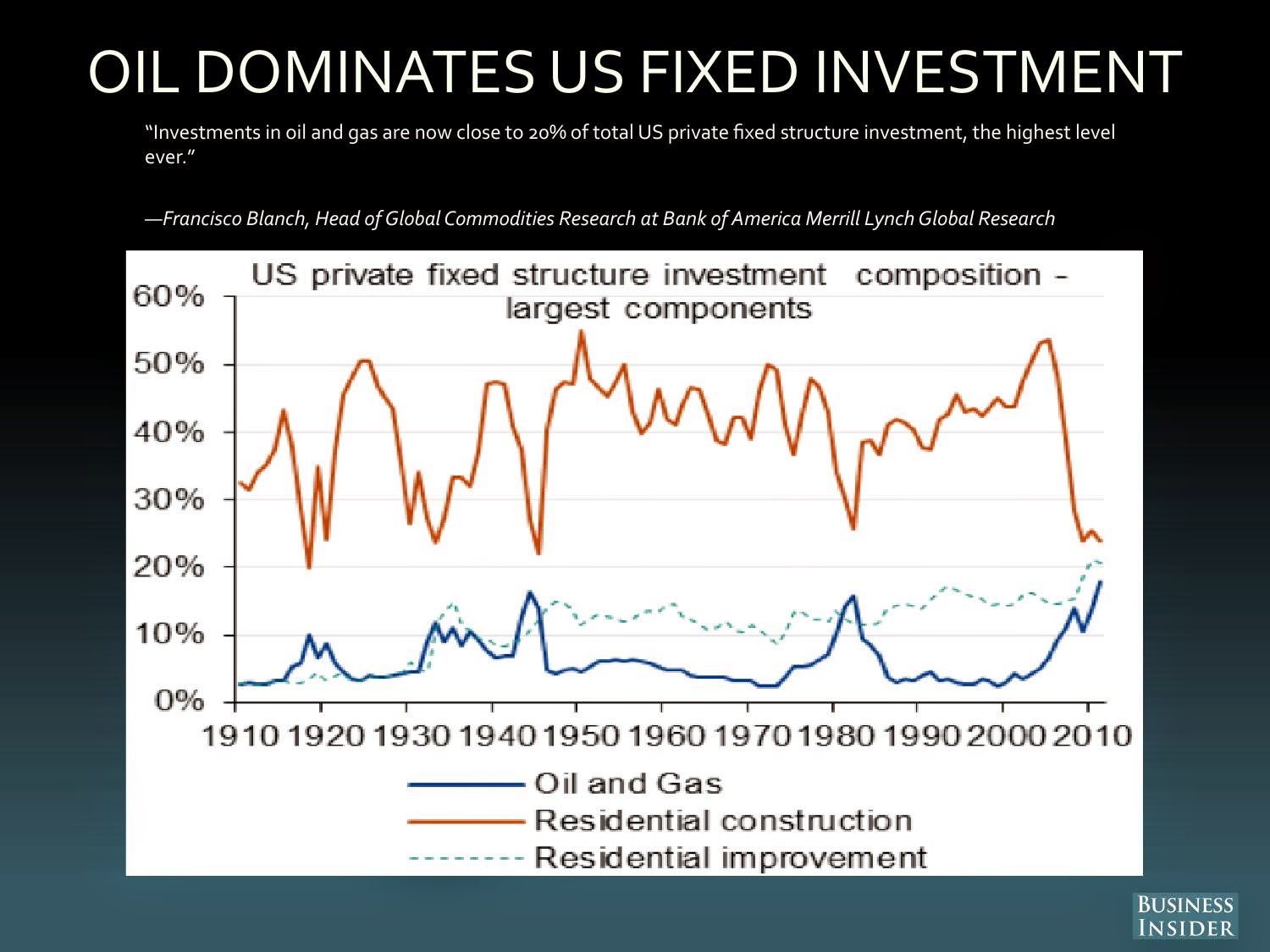
Another forward looking indicator is US residential construction investment which is slowing:


Finally, the collapse in oil prices is telling you that the global economy is stagnating and that inflation is not likely to be a concern in the short to medium term (lower inflation = economy not operating at full capacity):


The other reason the US economy will slow in the short-medium term is that a significant part of the US economic recovery has been driven by fixed capital investment in the oil and gas industry. With oil prices falling, we are likely to see less investment activity. It depends how much further oil prices fall, but WTI would need to fall below $80 before we start seeing projects suspended.


Of course falling oil prices are also beneficial to US consumers who will be paying less to fill up their cars. It is often remarked that a falling oil price is like a tax cut for consumers who will now have higher discretionary incomes. The falling oil price is a mixed bag for growth but inflation is definitely less of a problem in the short-term.

There are other macro risks including geopolitics and further strength in the USD, which would slow down the US recovery. Until those risk scenarios materialise, the US economy should continue to heal albeit at a slower pace. The Fed is unlikely to increase rates until wages begin to rise and inflation becomes a clear problem. Given the perception of a fragile recovery, the Fed will be reluctant to raise the Fed Funds Rate/IOER early. I do not see the Fed increasing interest rates in the first half of 2015 and are now less likely to hike rates in the second half of 2015.

To summarise:
  • Forward looking indicators are warning that the US economy's momentum is slowing along with the global economy
  • Inflation less of a concern given market expectations and falling oil prices
  • Deflationary forces will prevent the Fed from increasing interest rates in the first half of 2015


22 October 2014

Review of Past Predictions

In my previous post, Mea Cupla, I discussed my new economic framework built on Money Realism with influences of Behavioural Economics, Post-Keynesian economics, some Austrian Economics (malinvestments) and a few others. Now it is time to review ALL my past prediction and make forecasts on what lies ahead using my new economic framework.

Anyway let's go back and review my posts:

First we have "Downfall of the US Empire". In this post I rebuke the debt incurred by the US in addition to "printing money" and QE. The error made in this post was to only focus only on the liability side of the US balance sheet and not the asset side. The US is the most productive and innovative economy in the world. Additionally, the US government has trillions of dollars worth of land and natural resource assets. When this is considered, the debt can easily be repaid. On a more technical note, the US government can avoid bankruptcy or default by monetising its debt. Therefore the debt is not a problem and neither is QE. The main limitation on endless government borrowing is inflation not the debt itself.

The next economic article I wrote was one entitled "Asset Bubbles" in February 2010. I recognised that asset bubbles are driven by irrationality, which aligns well with my current view of understanding behavioural biases when analysing the economy. I then write about property bubbles and predict Sydney's property market will crash. While I still think the Australian property market is prone to a correction. I no longer think a crash is likely given the government imposed supply constraints and because the RBA can still cut interest rates or even purchase RMBS to ease the supply of credit for mortgages. But what is the difference between a correction and a crash? I'm going to use the same loose definitions of both as they apply to the stock market. A correction is a decline of 10% and a crash is a rapid decline in a short period of time. Let's say a crash is 20% or more.

I then go on to identify China as a bubble, which I still think is true given the enormous expansion of credit used to fund unproductive investments. The main lesson to learn from this post is that when price deviates from its long-term average, it cannot be said that there is a bubble. There may be legitimate fundamental factors driving prices and as long as that does not change, prices will remain elevated. This is not true for China because even though they will be a powerhouse economy of the future, no economy is immune to a bust following a massive credit boom. You can read about my dire predictions on the Chinese economy here.

2012 Articles

The next post I wrote is in February 2012 on fiscal policy. I criticise government borrowing and cite a few reasons why. The primary claim I make is government borrowing crowds out private sector borrowing. This is only true when the economy is booming, bond yields are rising and inflation is a problem. More government borrowing in this scenario would put upward pressure on interest rates economy wide. My original claim was wrong in normal times but correct when inflation is high.

In July 2012, I wrote about why we want a stronger currency. Ultimately we should not want a strong or a weak currency but one that reflects the fundamentals. Now obviously that is as ambiguous as it comes in economics. But the main point is that a strong currency will hurt domestic exporters while consumers will benefit from cheaper imports. Conversely, a weak currency will boost exports but foreign imports will be expensive. Central banks are conflicted on this topic because a strong currency will reduce imported inflation while reducing employment in export industries and vice-versa with a weak currency. Trying to stimulate the economy by purposely weakening the currency is ineffective as Japan has recently found out (research from GS).

In August 2012, I wrote about how banks feed off inflation. This is probably the best example of my incorrect understanding of the monetary system. I explicitly reference the money multiplier when talking about fractional reserve banking. What's funny is that the conclusions about banks needing inflation to generate increasing profits are correct. If the money supply contracts because people are repaying loans, then the interest income banks receive decline, which will impact their profits. The main point is that we have a credit based monetary system that requires inflation or else the system implodes in a deflationary spiral. Hence why central banks are terrified by the prospect of deflation.

2013 Articles

Moving along to March 2013 when I wrote an article gloomily entitled, "The Keynesian Endgame". But wait till you read the first sentence: "I absolutely despite the Keynesian school of economic thought." I can only shake my head at this ridiculous diatribe. Having actually read Keynes, he's not as bad as the Austrians portray him to be. While the vilification of Keynes was gratuitous, I still believe the crux of the article. The main message is - the current debt-laden world is unsustainable. I'll address this point in the months ahead.

In June 2013 I wrote an article provocatively titled, "Apocalypse Now", in which I outline the main risks I see for the Australian economy. This article was light on theory so there's not much revision here except for my comments on Japan. Obviously QE is not inflationary for the general price level in the economy. It could be said that QE results in asset price inflation but that's not inflation in the traditional sense of the word. I still retain my bearish bias on the Chinese economy which you can read about here. I later mention the main risks to the global economy which is still 100% valid today:

"There are also known unknowns (as Donald Rumsfeld likes to say), which include terrorism, global health pandemic (watch the movie Contagion), natural disasters, wars, government policies (QE, protectionist trade and capital policies)."

This year we've seen the war in Ukraine and in Iraq with ISIS. Then there's the global health pandemic of 2014 - ebola. Thus far the markets seems to be shrugging off these risks. But it only takes a slight escalation in the spread of ebola for example, before the market rapidly reprices risk to the detriment of asset valuations. I still believe the following prediction made in June 2013 will eventuate:

"My predictions: base case rates go lower in Australia to 2% and in combination with the lower AUD (70c-80c) causes the economy to re-leverage. Worst case scenario is an implosion in Asia due to any of the factors mentioned above, will cause rates to go to zero in Australia and the AUD to go sub 50c as commodity prices collapse and the high unemployment prevents credit growth from occurring.  It’s difficult to see any bullish scenario simply because “we’ve been there and done that” for a few years now."

The next post I want to look at is one entitled "Escape is Impossible" in December 2013. Back then I realised that QE from the Fed was largely ineffective, albeit for the wrong reasons. This is the post where I start getting more things right than wrong.


There you have it. A  quick review of my past posts and what I missed or got right. It's difficult to believe that for years I had been operating under a flawed economic model, leading to erroneous conclusions. While I have updated my knowledge, most economists still don't understand the monetary system an in particular the concept of endogenous money. It will only be a matter of time before they change their views (I hope) because their predictions will be consistently wrong.

Updated Predictions and Forecasts

As promised, here is a summary of my updated forecasts and theories:
  • US does not have a debt crisis due to enormous asset side of balance sheet
  • Australian property market likely to fall at least 10% as economy enters recession by 2016 (same as before)
  • China will crash by 2016 (same as before)
  • Government borrowing does not reduce business borrowing (most of the time)
  • Engineering a weaker currency through monetary policy is not a path to sustainable economic growth
  • Keynesian policies such as deficit expanding tax cuts or infrastructure investments are beneficial during a recession 
  • The reason why high inflation won't occur is because credit growth is demand driven (as MR states) and as we've seen over the years in the US, Europe and Japan, lower interest rates have not engendered credit growth
  • Basically more debt in the system results in less growth because interest must be paid from income (Post-Keynesian theory of financialisation of the economy), which means less disposable income
  • Deflation is occurring across the world but could be one or a combination of many reasons including: the accumulation of private sector debt, demographic trends, globalisation or income/wealth inequality (Post-Keynesian reason)

17 October 2014

Mea Culpa

"When the facts change, I change my mind. What do you do, sir?" - Unknown quote

Rebuilding the model

Part of the learning process is acknowledging the limitations of your understandings and when a better theory or model of the world is developed then one must reject any contradictory models or theories. I say this because a year ago you could have described my economics views as Austrian, with little tolerance for government intervention. Whether it be regulations, taxes or spending - the less the better.

That changed towards the end of 2013 after I learned that the Austrian model of banking and money is inaccurate when applied to the current monetary system (it may have been accurate decades ago). Further doubts arose as I learned more about cognitive bias and behavioural economics/finance. These realisations invalidated my economic view of the world and I began to question everything including: if free markets were really the best way to allocate resources? and does government have a role to play during recessions? But I first had to address how I came to be so wrong in the first place.

I looked at my economic education sources: Mises.org, ZeroHedge, Peter Schiff etc. What do they all have in common? All have a strong libertarian political bias and hence also share a pro-free market or Austrian economic view. I couldn't believe it, I had fallen for confirmation bias. My own libertarian political bias had guided me to embrace an economic school of thought which supported absolutely free markets with little room for government intervention. I knew that any cognitive bias distorts one's perception of reality and if I wanted to know how the economy really operates, I would need to research other economic theories and schools of thoughts objectively.

Like a phoenix rising from the ashes, a new model is born.

I started my post-Austrian economic journey when I discovered Modern Monetary Theory (MMT) and Money Realism (MR). At first their theories sounded heretical. They were saying things like the government can never default and that bank loans create bank deposits. Like any objective critical thinker, I learned more about it and found their monetary model to be a more accurate portrayal of the current monetary and banking system than any Austrian model.

Earlier this year, the Bank of England released a paper (highly recommended reading to understand money creation and QE) explaining the monetary system, which matched the model portrayed in MMT and MR. It also means that it punches holes in Austrian theory with conclusions such as:
  • Banks don't rely on deposits to create loans
  • Savings that are deposited in a bank do nothing for the economy. Hence savings deposited at a bank or what Keynes described as "liquid assets", results in less economic activity
  • A central bank conducting QE is not the same as the "money printing" in Zimbabwe or Weimar Germany
I still think the Austrians have a lot right about high levels of government intervention harming the economy and their theory of malinvestment has some merit. But their monetary model (loanable funds model) needs to be discarded to reflect the current reality. In response to these claims, Austrians retort that they describe the real economy and not the fiat/nominal/accounting economy. This may be true, but at least acknowledge that the loanable funds model (people save and then banks lend those savings out) embedded in Austrian Capital Theory is utterly wrong.

So what are my general beliefs and views now? After being intellectually burned on Austrian theory, I've become a strong proponent of objectivity and observation rather than developing a theory and then imposing it on the world. In Nassim Taleb's book Antifragile, he discusses this thought process and classifies it as phenomenology. Simply put: don't worry about the theory, just know what works.

Much of mainstream economics is influenced by political bias and therefore any accurate economic school of thought must be apolitical. Given this premise, I was forced to reject MMT because they are tainted by a strong left-wing political ideology which favours pervasive government intervention. This leaves MR which explicitly states its focus on the "operational realities of the current monetary system". Political decisions are left to others and have no place in MR. As nerdy as this sounds, I fell in love with this principle.

You can learn about Money Realism at pragcap.com run by the wonderful and erudite Cullen Roche.

What are my current economic thoughts?

I think everything that MR claims is true when compared to all other economic schools of thought. Cullen does a fantastic job of comparing the other economic schools here and here.

One of the important tenets of MR is that we are all irrational and thus, markets are not as efficient as we believe (you probably already knew that). This does not imply free market capitalism should be rejected. It just means pure capitalism is not the ideal outcome for the economy.

Government intervention can be a net benefit to the economy in a recession if done correctly. There is a fine line between allowing an unsustainable boom or bubble to deflate and preventing a potential depression. Policy makers must not prop up inefficient businesses if they are the by-product of poor decisions by investors (similar to the Austrian malinvestment theory).

I also place a lot of value on cognitive bias and behavioural economics/finance. It explains everything from booms/busts (herd mentality and loss aversion) to people claiming the data is manipulated to show no inflation (confirmation bias and just batshit crazy).

I also have incorporated the main idea of Antifragile by Nassim Taleb, describing things that become stronger (antifragile) not weaker (fragile) after being temporarily exposed to a stressor.

Cannot recommend this book highly enough!

An economy is just the aggregate of people's spending decisions and because of behavioural biases like overconfidence and the herd mentality, excesses can accumulate in the system. Without the full impact of a recession, risk taking will become irrational as investors expect fiscal and monetary stimulus to limit their losses (moral hazard). This is similar to Minsky's Financial Instability Hypothesis which states stability creates instability. In layman's terms, the more stable the economy, the more risk taking which results in future instability. Again you can see the influences of behavioural economics with overconfidence etc.

This is the main reason I strongly believe a recession should be allowed to run its course. After a recession, the system becomes stronger as the weakest businesses are liquidated and the factors of production that were previously used inefficiently are now reallocated to the strongest and more efficient businesses. The government can support unemployed people through welfare and can stimulate economic activity but cutting taxes and allowing the deficit to increase. These measures must be taken ONLY after the unsustainable excesses and malinvestments of the boom are liquidated.

What lies ahead...

Now that I have a better understanding of the reality of the banking system, it's time to update my predictions. My own view is that all developed economies are sinking into Japanese style debt deflation. The conventional monetary policy is that lowering interest rates encourages more borrowing which is then spent on investment by businesses and consumption by households. Implicit in this theory is that we can reduce the severity of recessions and the economy will grow forever. Is that possible? Can we just always lower interest rates and the economy keeps on chugging along to new heights? Remember that old phrase when someone tries to convince you that some form of government intervention makes everyone a winner, there's no free lunch in economics. There are other confounding factors such as demographic trends, inequality and technological progress fuelling the deflationary trend which I will discuss in future posts.

But that's it for now. In the next post I will be reviewing my past predictions and updating my forecasts for the future using my current and more accurate understanding of economics and finance.

25 June 2014

Mining Subsidies - Analysis of Ross Gittens's "Mining boom policies dig a hole for economy" - SMH 24/6/14

Are we subsidising the mining industry too much? Yes is the answer according to Ross Gittens in his recent article. The article comes on the back of a report to be released by the Australia Institute, alleging that the mining industry receives numerous subsidies. Despite receiving numerous subsidies, the mining industry contributed, "$121bn paid in Federal and State revenues over the last six years," according to the Minerals Council of Australia. That's an average of about $20bn every single year. Compared to assistance AI calculations: "the states gave the mining industry $3.2 billion in concessions in the financial year just ending."

At the end of the article Gittens says: 
And this while governments, federal and state, are crying poor and cutting spending on many worthy causes.
Apparently, the end of the age of entitlement applies to poor people, not to big corporations. And that’s true for foreigners, not just locals.
As Ian McAuley, of the University of Canberra, has pointed out, we’re slashing our planned spending on foreign aid because we can no longer afford such generosity, but by abolishing the mining tax we’re being very generous to big foreign mining companies.
This makes sense? 

To cut a long story short, Gittens wants the mining industry to pay more tax but doesn't say how much more.

While I agree that subsidies should be reduced or better yet abolished, taxes and royalties should be reduced to offset the reduced subsidies. The result of which is a mining industry that builds its own infrastructure and has the funds to do it from reduced taxes and royalties. Then we could say we no longer subsidise the mining industry which would also reduce compliance costs and other inefficiencies associated with regulations.

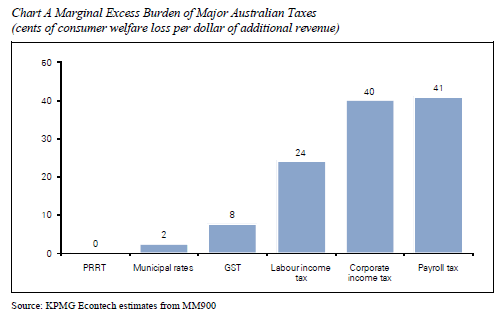
Once that is done, then we can have a debate about the mining industry paying more tax. Indeed taxing natural resources is one of the preferred factors of production to be taxed. A tax on minerals is more economically efficient than incomes taxes and corporate taxes. See the next chart by KPMG in a submission to the Henry Tax Review (where PRRT is the Petroleum Resource Rent Tax similar to a mineral's tax in that both tax factors which are completely immobile):


Does that mean I support the current "mining tax" that the Abbott government plans to scrap? No. The current mining tax bares little resemblance to the mining tax originally suggested in the Henry Tax Review. I agree that the current mining tax should be abolished. If you want a mining tax, then do it right and reduce the inefficient tax burden elsewhere in the economy (cutting payroll tax, corporate tax or income tax - see KPMG chart above). Doing it in this fashion is revenue neutral in the short-term and revenue positive in the long-term as economic growth is larger due to more efficient taxes.

Gittens article starts of well by describing the benefits of foreign direct investment but then entangles itself in a messy debate about the mining industry paying more tax. Unfortunately Gittens ignores the numerous savings that could be achieved if government was more efficient (as proposed by the National Commission of Audit) and instead calls for more economically harmful tax revenue to fund political and social programs. 

10 March 2014

Bear in a China Shop


Photo: Wen-Chun Fan - CNN


It’s been a few months since I placed China firmly in my crosshairs. Since then, the evidence continues to portray a mind-boggling debt bubble, not only in the property and construction markets, but also in corporations financed by the shadow banking sector.

Initially, I thought the main problem was the property market but after realising how leveraged the corporate sector is, my attention turned to the copper, coal and iron industries with connections to the shadow banking system. My updated thesis is that the overleveraged corporates (specifically the coal mining, iron ore, copper, cement and property industries) will be the first to crack causing defaults in the shadow banking system. Loan defaults inevitably lead to tighter credit conditions and further defaults, falling asset prices and collateral impairment. The vicious cycle is complete and suddenly the economy is in free-fall.

There is no question in my mind that the defaults will occur but what will the policy response be? The Chinese government will respond with bailouts, debt guarantees and more fiscal stimulus. Despite the financial firepower that Beijing has, the scale of the problem is so vast that it will overwhelm the economy before Beijing reacts.

But let’s say that Beijing is successful in preventing a few defaults initially. The distortion of risk will perversely cause investors and speculators to pump more funds into bad investment products as any losses incurred will be recovered via a bailout (increasing moral hazard).

The main catalysts for the China collapse in order of most likely to least likely are:
  • Government inaction (no bailouts) that results in tighter credit conditions or intervention to deliberately depreciate the Yuan (reversing leveraged carry trades)
  • Falling commodity prices causing collateral impairment, forcing collateral liquidation which causes further falls in commodities in a self-reinforcing cycle
  • Defaults relating to property market speculation occur causing a downturn in the economy and falling demand for commodities

In this post I will provide evidence for the aforementioned conclusions. You can decide for yourself if this is just doomsday permabear talk or if China is on the precipice of the abyss.


Chinese banks and bad loans

The borrowing binge of the last couple of years has seen a rise in Non-Performing Loans (NPLs) for the largest Chinese banks. Beijing has tried to clamp down on the leveraged banking sector and the reports of rising NPLs is seen as a pre-emptive move to mitigate a future surge in NPL ratios amid rising defaults in 2014.

This raises suspicions that if the largest banks are reporting rising NPLs, one can only imagine the amount of bad loans in the opaque shadow banking sector. To illustrate the relative size of the shadow banking sector, the five largest state owned banks and the 12 largest national lenders control more than 60% of China’s banking assets with other financial institutions owning the rest. There is cause for concern with NPLs rose by 28.5bn Yuan in last quarter of 2013.

NPL ratio rising since Q3 2011 (time axis reversed)

Despite the worrying trend in NPLs, this has not dampened confidence in lending. In fact, total social financing increased by the largest amount in history:

Credit boom continues

Shadow banking

At the heart of the excessive credit is the shadow banking system in China. Essentially, the shadow banking system refers to the unregulated financial intermediaries and the investment trust products they produce. These trust assets are marketed as “wealth management products” (WMPs). A good analogy for WMPs is the mortgage backed securities that went bust during the GFC. But instead of institutions buying these products, it is small retail investors and instead of mortgages backing these trusts, it is loans to corporations and local governments. The growth in these trust assets and WMPs have been enormous to say the least, with growth in the last few years averaging 40%p.a.

Trust asset boom is unsustainable

Bailouts and moral hazard

One of the counterpoints put forward by the China bulls is that the government can just expand credit and bail everyone out. Unfortunately this creates huge moral hazard and encourages reckless risk taking throughout the entire system.

Wealth management Products (WMPs) offering double digit returns are presumed by investors as being guaranteed by the issuers. Avoiding the default has misleadingly confirmed that presumption leading to that perennial distortion of risk… Ye Olde Moral Hazard.

In a JPM report they conclude, “Avoiding defaults will only delay or even amplify the problem in the future.” Get ready for the first wave because in the short-term there are a large volume of WMPs maturing which poses substantial rollover risk.

To summarise, bailing out losing trust products creates moral hazard and exacerbates the risk of further volatility. The lack of perceived risk will entice further investment, further inflating the bubble and worsening the inevitable crash.

Chinese commodity collateralised loans

While the central government is aware of the accumulation of leverage in the system, the crackdown on lending has driven companies to use raw commodities such as iron ore, copper and coal as collateral. These schemes increase the risk on loans by exposing lenders to a fall in commodity prices which will impair collateral. This creates the dual risk of either loan defaults causing collateral to be liquidated or commodity prices falling first and the value of collateral being insufficient, leading to lenders calling for more collateral.

Given the above, the record build-up of iron ore inventory at Chinese ports is a worrying sign and could precipitate a collapse in commodity prices:

Inventory piling up and does not bode well for prices
Source: Unknown
Already iron ore prices are declining as inventory is at all-time highs. Adding to the pessimism is falling industrial demand and speculative activities by commodity traders. There is anecdotal evidence that commodity importers have been using their inventories as collateral to bet on Yuan appreciation. Some have even borrowed dollars, converted them to Yuan and invested the money in “high yielding” accounts.

Iron ore prices at new monthly lows
Source: Barchart
From SoberLook, “With banks cutting back lending to this sector and the recent decline in the Yuan, traders are being forced to dump inventory and that is sending prices lower and causing some mills to close. All of this points to tighter credit, weaker demand and slower industrial activity going forward.”

China upcoming trust defaults

There have already been reports by the media of potential trust defaults. The upcoming trust defaults seem to be concentrated in Shanxi province and in the coal mining industry. Repayments may be extended to avoid default in the near term and Coal mine trusts are most likely to default because coal price has fallen recently.

The maturity wall is fast approaching

Chinese housing market

Residential property in China’s 70 largest cities is also coming off the boil. It is still early days but if the fall in property prices gain momentum, this will dampen the speculative frenzy. A rapidly cooling property market and falling coal and iron ore prices will compound the contraction in credit growth as trust products default.

Chinese households have invested vast amounts in property and are now massively exposed to a housing bubble. China housing prices have increased substantially with households holding on average 65% of their assets in real estate and 90% of households already owning a home. Supply is coming to market at a rate of 15mil new units per year.

Chinese house prices in a speculative fervour

Impact on the world

I remember watching an episode of NCIS and the veteran detective saying, “I don’t believe in coincidence.” There is a link between Chinese capital flows and the US Federal Reserve’s QE program. We have seen the effect QE tapering on emerging markets (EMs) as the carry trade unwinds. Tapering will speed up the withdrawal of capital causing financial conditions in China to tighten. This is relevant because the Chinese trust sector is partly financed overseas. Low global rates and expectations of perpetual Yuan appreciation have resulted in higher investment returns promised by trusts. Part of the debt raised overseas is probably invested in the trust carry trade. Hong Kong banks are big participants and if China goes bust, you can expect the Hong Kong banking system and property prices to come under pressure.

Honk Kong financials are heavily exposed to Chinese borrowers
BAML says if China blows up there will be safe haven bids for developed market (DM) government bonds, overseas property and precious metals. One of their alleged smartest clients said, “The main theme in the past 5 years was QE. If that is coming to an end, investments and themes that worked in the past five years must therefore be questioned.” This is an important reminder about the immense global implications of any crisis given China’s contribution to world economic activity.

Yuan leveraged bets

The “managed economy” that China espouses has resulted in massive speculation in property, commodities and of course the currency. China has steadily allowed the Yuan to rise and has gradually allowed increasing volatility over the years. Corporations have taken out derivatives known as target redemption forward contracts to bet on the increasing currency in what many have described as the “easy money, no risk, no brainer” trade. Unfortunately, the government has ended the party in recent weeks with the Yuan depreciating significantly during a short period of time. While in absolute terms the move is not dramatic, it does cause the problem of huge losses for corporates who are exposed to these leveraged derivatives.

To summarise the problem, the longer the currency depreciates the more losses are sustained. Even if the currency remains below certain loss thresholds, collateral or margin calls will be used to reduce the risk of positions for banks. This means corporates will have less cash and will become more leveraged. You can read in more detail about the derivatives here.

Arguments against a China collapse

Another argument against a major crisis is that China runs a“non-commercial” financial system, that there is no counterparty risk since it’s just one giant state run labyrinth and bailouts will flow at the first sign of trouble.

Such a system is not immune to shocks and is in fact more fragile and more susceptible to adverse events. I have already mentioned that avoiding losses will result in moral hazard and lead to more risk taking and leverage. Eventually the boom will become too inflationary (as seen in 20%YoY property price increases) and they will be forced to tighten, which then causes tighter credit and eventually defaults that further destabilise the system.

The “China is immune view” also emphasises that market forces deal with problems and governments do not. Loss making decisions are eventually purged from the market, while they are perpetuated and exacerbated in a government controlled system.

Picking the top in the market

There’s that old adage in the investing world that the markets can remain irrational longer than you can remain solvent. This is especially true for bearish investors and traders calling the top in any bubble. I have previously said I expect Australia to be in recession before 2016 based on many risks including a Chinese financial crisis. That is still my base case. In making this prediction, I am committing the cardinal sin of picking the top of the market or trying to time the collapse. Jim Chanos (runs a short-selling hedge fund) has been predicting the Chinese collapse since 2009 and five years later it still has not happened! I am happy to be wrong on timing the crash because I am convinced that it will happen given all the facts listed above.

Conclusion - warning signs

We all know that inflationary debt bubbles burst eventually because central banks and governments understand the instability caused by rampant leverage and speculation. By then it is too late, and the economy must undergo a remedial recession to purge the malinvestments.

China’s highly leveraged economy has numerous risks that would trigger a chain reaction throughout the entire system. The property market, the commodity market, the currency market, the banking system and leverage corporations form a powder keg that will soon find a spark.

When someone says, “China is immune”. What I hear them saying is, “this time it’s different”. The same denials you hear when history has proven that credit fuelled bubbles never last. You will always hear the same bubble mantras that defy logic like, “property prices never go down” (US sub-prime 2007), “earnings don’t matter” (Tech boom 2000), “they have a super-productive economy and are different” (Japan 1990) etc. When central planning and debt is involved, nothing ever changes and you can expect history to repeat again and again and again.


Source