Showing posts with label Fed. Show all posts

16 August 2015

Austrian Malinvestment Theory

A new train station in Wuhan (Central China) completed at the end of 2009

While a lot of what the Austrian School of Economics says is just political theory dressed up as economics, some of their theories may be sound in the real world. One such theory is the theory of malinvestment.

Malinvestment is a mistaken investment in the wrong line of production, which inevitably leads to wasted capital and economic loss, subsequently requiring a reallocation of resources to more productive uses.1

The theory of malinvestment is a critical part of the business cycle according to the Austrian school. They blame the government either through its spending decisions or through the central bank for causing these market distortions resulting in misallocation of resources and the malinvestments which inevitably have to be liquidated.

To the neutral observer, one may be quick to dismiss this as the standard Libertarian anti-government rhetoric. However, it is widely accepted that poor central planning can lead to massive investments that are proven to be unproductive and misaligned with consumer demand.

This blog post follows the post on Minsky's Financial Instability Hyporthesis and tries to explain the business cycle phenomenon. The question is whether the government, the central bank and the fractional reserve system are the cause of the bad investments or is it more along the lines of Minsky's FIH - that the boom-busy process is inherent to a capitalist economy. I believe that both can be correct. The private and public sector are prone to making bad decisions. The government's decisions have greater economic impact but the private sector can also generate asset bubbles that can have greater consequences than any government decision ever could.

Krugman's Criticisms of Malinvestment Theory

Paul Krugman describes this as "Hangover Theory". He first states that investment cycles should not be assumed to correlate with the economic cycle. He makes the point that any reduction of investment will result in an increase in consumption because someone's spending is another's income. He also points out that every industry feels the pain, not just the investment sector.2

Krugman then states "A recession happens when, for whatever reason, a large part of the private sector tries to increase its cash reserves at the same time." He then suggests an increase in the money supply after the private sector writes off its bad investments because after the write off, there is only idle productive capacity left.2

Krugman attributes the appeal of "Hangover Theory" to counter the perceived statist implications of Keynesianism and describes the theory as "intellectually incoherent."2

Examples of malinvestment

The clearest examples of malinvestment are those government projects that cost billions and eventually prove to be white elephants because the economic and social benefits are tiny compared to the cost of the project. However, the worst malinvestments occur when the private sector AND the government work together to create gargantuan investment and asset bubbles.

A great example is the property and construction boom in China. After 2008, the Chinese government instructed its banks to lend and finance the construction sector. We saw the creation of ghost cities and the demand for iron ore (used to create the steel needed to build) sky-rocket. The Austrians would describe this as a false price signal, which caused iron ore miners around the world to increase their production capacity. Australia was one of the chief beneficiaries with mining investment driving much of the economic growth seen post-2008. In the last year or two, we have seen the Chinese economy roll over and with that the price of all commodities. The demand for steel has plummeted and the iron ore price has crashed. Just a few days ago BHP announced its third round of job cuts which reflects the adjustment to the overcapacity now laid bare in the mining sector.

Other examples from history include the US housing bubble. Interest rates reached 1% in 2002-2003 before slowly rising. Government policies encouraged and supported lending to sub-prime individuals through mandates and GSEs like Fannie Mae and Freddie Mac. Of course there was also widespread fraud on the part of the private sector. But the question remains, if interest rates bottomed at 2% instead of 1%, would the fallout have been far more limited?

Conclusion

One should be cautious when reading anything from the Austrian school, simply because of the political bias that is the foundation of their economic thought process. If an objective observer sees government intervention in an economy leading to investment booms and later a bust, it would be apt to fault the original government decision. It must be said that the government is not the only one making bad investment decisions. The private sector does it all the time and as Minksy's theory postulates, it may be inherent to a capitalist economy. Both theories importantly point out that the private sector makes mistakes, which many mainstream economic models seem to ignore.

References

  1. Wiki.mises.org, (2015). Malinvestment - Mises Wiki, the global repository of classical-liberal thought. [online] Available at: https://wiki.mises.org/wiki/Malinvestment [Accessed 16 Aug. 2015].
  2. Krugman, P. (2015). The Hangover Theory. [online] Slate Magazine. Available at: http://www.slate.com/articles/business/the_dismal_science/1998/12/the_hangover_theory.single.html [Accessed 16 Aug. 2015].

30 October 2014

Same Foundations, Different Perspectives


If you have been reading my blog recently then you know my economic view of the world is based on Money Realism. While this provides a good foundation for understanding the monetary system, predictions may vary among its adherents. Simply put, I am slightly more bearish on the US economy than Cullen is.

Cullen points to three improving macro indicators: retail sales, initial jobless claims and manufacturing production. The problem with looking at these indicators is that they are all lagging and only offer the historical trend. One must look at forward looking markets or leading indicators. I asked Cullen if he looks at forward indicators and if they are showing any divergence from the lagging indicators to which he responded:

"My general view is that the macro picture in the USA has not changed in recent weeks and that Mister Market was just having an Ebola and Europe scare…"

It appears Cullen has a sanguine outlook for the US economy but let me tell you what I am seeing...

The bond market is one forward looking indicator and it is predicting low inflation. Lower inflation usually means a lack of demand in the economy and entails an extension of the accommodative monetary policy set by the Fed. In other words this lowers the probability of interest rate increases in the future.

Note the sharp drop in the back end of the US inflation curve over recent months
Another forward looking indicator is US residential construction investment which is slowing:


Finally, the collapse in oil prices is telling you that the global economy is stagnating and that inflation is not likely to be a concern in the short to medium term (lower inflation = economy not operating at full capacity):


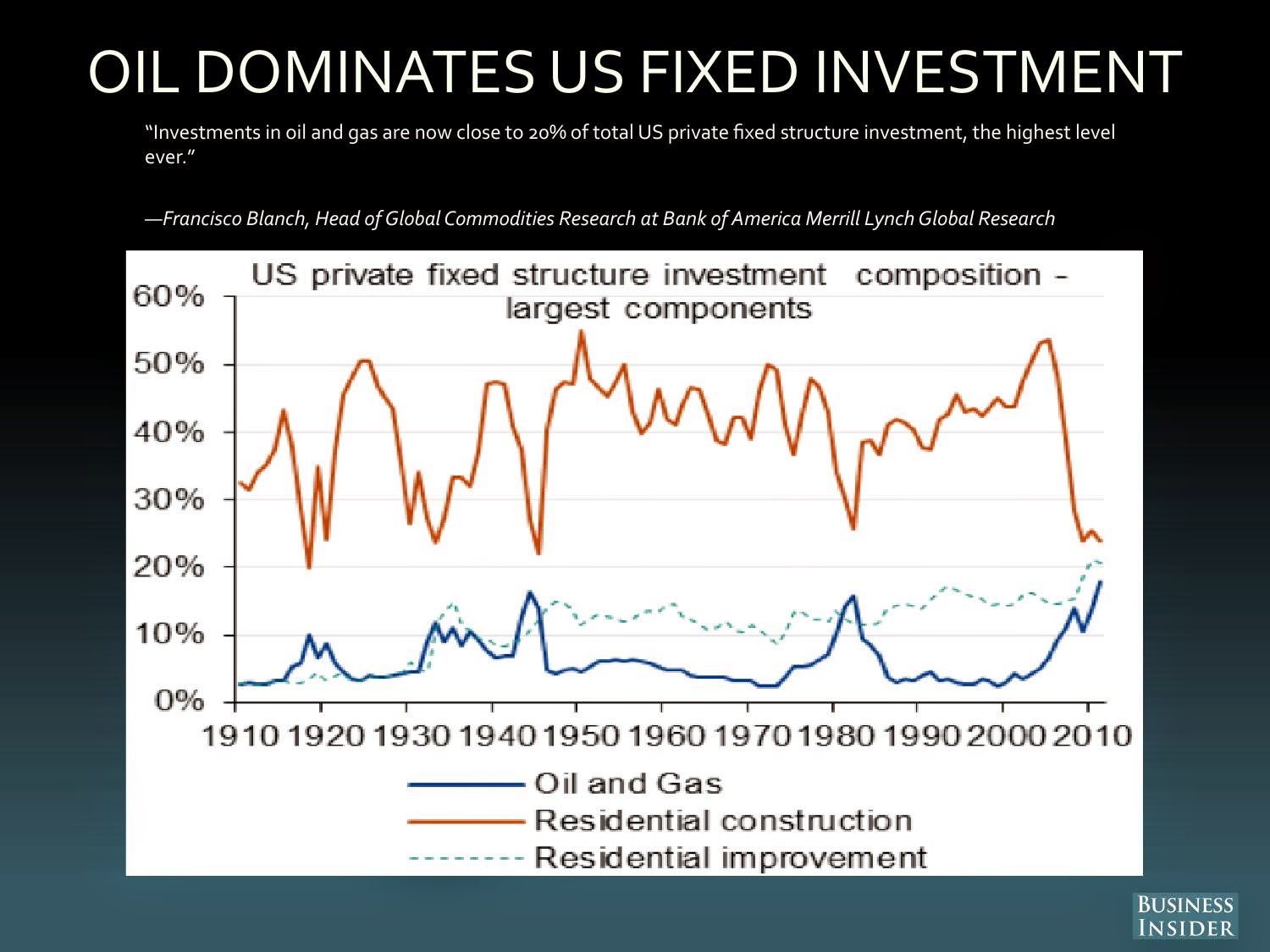
The other reason the US economy will slow in the short-medium term is that a significant part of the US economic recovery has been driven by fixed capital investment in the oil and gas industry. With oil prices falling, we are likely to see less investment activity. It depends how much further oil prices fall, but WTI would need to fall below $80 before we start seeing projects suspended.


Of course falling oil prices are also beneficial to US consumers who will be paying less to fill up their cars. It is often remarked that a falling oil price is like a tax cut for consumers who will now have higher discretionary incomes. The falling oil price is a mixed bag for growth but inflation is definitely less of a problem in the short-term.

There are other macro risks including geopolitics and further strength in the USD, which would slow down the US recovery. Until those risk scenarios materialise, the US economy should continue to heal albeit at a slower pace. The Fed is unlikely to increase rates until wages begin to rise and inflation becomes a clear problem. Given the perception of a fragile recovery, the Fed will be reluctant to raise the Fed Funds Rate/IOER early. I do not see the Fed increasing interest rates in the first half of 2015 and are now less likely to hike rates in the second half of 2015.

To summarise:
  • Forward looking indicators are warning that the US economy's momentum is slowing along with the global economy
  • Inflation less of a concern given market expectations and falling oil prices
  • Deflationary forces will prevent the Fed from increasing interest rates in the first half of 2015


19 December 2013

Escape is Impossible

Bernanke taper time
Photo: Bloomberg

Since the end of 2008, the US Federal Reserve has cranked up its monetary easing policies several times to get the US economy growing again. The Fed is like the gambler doubling down on their losing bets, hoping for that next big win which will erase all their losses. The Fed is hoping for that next big win in the form of sustainable job creation of at least 200K new jobs every month and the unemployment rate to fall to 6.5%. Few have asked the question of whether the Fed’s monetary policies even work given the build-up of excess reserves on the balance sheets of banks. Yet here we are, a year on with the most expansionary monetary policy ever and we are debating if the economy is ready for a taper. In economics there is the law of diminishing returns and with the Fed resigned to continually buy bonds, the effects of the purchases has diminished to the point where the Fed has become impotent.

The problem for the Fed and other central banks is that as soon as they set a target for withdrawing stimulus policies, the markets anticipate it months in advance which brings forward the effect on the economy. This is the phenomena of reflexivity that George Soros referred to whereby the economy affects financial markets and importantly, the financial markets affect the economy.

First blood
In the middle of 2013, the yield on the US 10 year bond rose from 1.5% to peak at 3% in just a few months. The rapid increase in rates also affected emerging markets (EMs), which had increased their monetary supply in recent years to offset capital inflows caused by the Fed’s quantitative easing (QE) program. When US yields rose, EM yields followed, and their currencies fell as capital flowed back into the US. This phenomenon caught the entire market with its pants down and highlighted the precarious position central banks had left credit markets in.

This was the market’s canary in the coal mine. Perversely, as capital flowed out of EMs and their currencies depreciated against the US dollar, EM central banks sold their foreign reserves to buy their domestic currencies and slow down the capital outflow. You can read about what happened to India here. If the Fed reduces purchases and foreign CBs are also selling US treasuries as we saw earlier this year, US yields will definitely rise as net supply dramatically increases. The effect of rising long-term rates on the US economy will end the recovery faster than you can say nominal GDP targeting! If EMs let their currencies depreciate, imported energy and food prices will rise and will be devastating to their economies. This is why we should see EMs reducing the reserves to support their currencies.

Everyone knows that the endless purchase of securities is unsustainable because at current projections the Fed will eventually monetise the entire US treasury supply. The problem with this outcome is that US treasuries are utilised to hedge investments and as collateral throughout the financial system. If treasuries become scarcer, liquidity will decline and we will see volatility in short-term rates. This means the Fed will stop ALL treasury purchases at some point. 

The Fed is buying most of the US treasury's supply

Repercussions
Rates will rise but will we see another volatile move or a slow melt? There is the argument that the dramatic move in rates this years was caused by MBS convexity hedging, which you can read about here. The next question is can the US economy handle a 10 year yield above 3% without sending the economy into recession? Or what about a confidence boosting 20-30% decline in the S&P500 as investors rotate from stocks to bonds? I’ll let you ponder that. Just look at how higher rates have affected US mortgage applications which hit a 13 year low to understand how higher rates shake up the economy:

US mortgage applications hit a 13 year low
Chart: Bloomberg

The negative economic impact will worsen as rates creep higher. Keep in mind that even with yesterday’s taper of $10bn, the Fed’s balance sheet continues to grow at $75bn per month:

The tiny taper
Source: Zerohedge

A nice trade to profit from further tapering in 2014 would be a US 2s10s curve steepener (long 2yr and short the 10yr). The spread is about 257bp and we would target a spread of 347bp which is 90bp higher. Use a stop loss of 30bp and exit either when the spread hits 347bp or hits the 200 day moving average (whichever occurs first).

While many speculate on when the Fed will completely exit asset purchases, they ignore the market and economic reaction in anticipation and fail to see the reflexive nature of the Fed’s policy.  The Fed will soon realise the futility of finding an exit, because when tiny steps to reduce purchases and sell their bond holdings causes huge moves in the market… there really is no escape.

18 December 2009

Downfall of the US Empire

The fall of an empire is usually caused by war. Just like the wars of ancient history, the wars of modern history have caused empires to go bankrupt and lose their superpower status. One only has to look back to World War 2 to see how war bankrupted the British empire. Britain was once the superpower of the free world but the war placed an enormous economic toll on Britain from which it never recovered and led to the isolationist US usurping Britain as the world superpower.

Once again we witness the fall of one empire (the US) and the rise of another (China). There is no doubt that the US stock market bubble of 2001 and the 911 terrorist attacks were massive shocks to the economy and confidence. The US Federal Reserve (Fed) then lowered rates to 1% and kept them there, for some time, to guarantee a recovery. What central banks fail to realise is that economic activity caused by lowering interest rates is an artificial boost to the economy. Money becomes cheap and the market reacts by borrowing more and accumulating more debt. Is this really economic growth? Was the NASDAQ bubble valuing companies accurately? In 2005, were US houses valued correctly? No and No. Central bank fuelled debt and the old cliché of "irrational exuberance" are to blame for the bubbles.
The great idea to invade Afghanistan and Iraq added more debt onto the US empire. Funding unwinnable wars with debt is how empires go into decline. The US government is now forced to use "quantitative easing" or printing money to fund their government expenditure. Imagine how much money would have been saved if Iraq had not been invaded or more importantly the thousands of lives that would have been saved on both sides of the conflict. These costs are now placing a huge strain on the US economy and will severely delay its recovery.


The government funded its wars with paper dollars. You can see that debt levels increased rapidly after Nixon closed the gold window. This is what happens when governments fund wars with debt. Eventually an economic crisis will hit government tax revenues hard and if the government had already been running a deficit then the deficit will become larger and eventually governments will print money to fund the war and to stimulate the economy.

Clearly after 2001, the price of gold accelerated upwards from $200/oz and has been growing exponentially since then.

The only way wars of aggression can be beneficial is if the resources that are captured are greater than the resources expended in fighting the war. Since Afghanistan had little economic importance and more strategic importance, we can say that this war had a purpose with no expected economic gain. On the other hand Iraq has major economic significance as an major oil supplier and posed little threat to global security (WMDs did not exist and the intelligence community knew this). We can therefore say that Iraq was war based on economics which secured future oil supply for the US.

Despite this gain, the war has no end in sight and every day the US military operated in Iraq is another US$ 150 million gone. Perhaps the strategists have worked out the future cost of oil being so expensive that the cost of the Iraq war is worth the gain in oil supplies secured. This is the only economic justification for the war and whether it is true will only be known years from now.

The only other economic justification for war is in self-defence, which should be self-explanatory.
We have looked at how the events of 9/11 set the US on a warpath that has bankrupted the nation. Osama Bin Laden's goal was to inflict terror on the US and send a message to the world. But he may have contributed to the downfall of the US.