Showing posts with label Libertarianism. Show all posts

04 December 2014

Economics and Politics

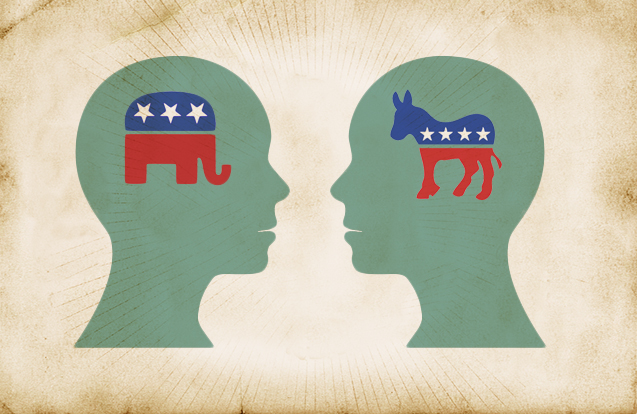
Source: Lena Groeger

One of the most important fields to emerge in the past three decades is the field of cognitive and behavioural bias. Countless experiments prove that we are all heavily biased decision makers and not the rational homo economicus purported by academic theories. Because economics is not a natural science like physics, conducting experiments to prove theories is not possible. Despite this, economists have tried to use maths (see econometrics) to prove various theories. The problem with constructing mathematical models is the reliance on assumptions and because there are so many moving parts in the economy, even a complex model will be inaccurate.

The lack of clear evidence results in multiple theories that are difficult to disprove. Usually supporters of a particular economic theory will find it magically aligns with their political bias. Obviously this is no surprise because confirmation bias is one of the most common biases we all exhibit.


For economics to really become practical and more scientific, biases must be eradicated when conducting economic analysis. When biases are mitigated, you don't get flawed predictions like "QE will result in hyperinflation" or "the budget sequester will cause the economy to go into recession."

For economics to be scientific and void of bias, it must be apolitical. I can only hope that one day economics will be apolitical. What will this day look like? It will occur when the vast majority of the economists agree on theories and predictions.

This is exactly why I support Money Realism because it tries to keep the politics out of economics. Cullen explains this in his summary of MR eliminating politics from economics:

"We probably can’t completely eliminate politics from economics, but MR is based on attempting to understand the monetary system and the economy at its operational level as opposed to focusing on providing policy solutions like so many other economic schools.   So we focus on things that are verifiable. For instance, how certain institutions are structured in specific monetary systems, how modern banking works, etc.  It’s all based on the view that a superior understanding of the money system comes from building an understanding of how the monetary “machine” works from the ground up.
We try, as best we can, not to provide prescriptive ideas and instead try to provide a set of understandings so that users of MR’s understandings can then decide on their own how best to implement policy.  We are not Keynesians, Monetarists, Austrians or any specific school at all.  MR is simply a set of understandings designed to describe the money system. 
Economics tends to focus on how certain policies can solve problems.  I believe economists should adhere to a Da Vinci method.  That is, when Da Vinci studied the human body he did not focus so much on how to fix the body, but how it worked.  Economists focus too much time trying to fix the economy and not enough time building a set of principles that define how it works.  If more economists adhered to a Da Vinci method I think better solutions would necessarily arrive. 
This is the primary strength of MR.  We don’t treat economics like it’s a religion.  Instead, we treat it like an evolving and changing science that requires flexibility and an open-minded approach.   As far as I know, there are few if any approaches to economics that provide this sort of approach."

Examples of biased economists

Some prominent economists that come to mind are Paul Krugman who has a blog titled "Conscience of a liberal". Just in case you did not know which political ideology he subscribes to. It is also clear that the Nobel Prize winner in economics, still does not understand how the banking system works when he claims that banks are not lending out reserves!:
"Banks are holding almost $2.7 trillion in excess reserves — funds they could lend out, but choose instead to leave idle."
Another biased economist that comes to mind is Stephen Koukoulas who frequently lambasts conservative politicians. He was an advisor to the former Prime Minister and leader of the Australian Labor party, Julia Gillard. Unfortunately his otherwise good economic analysis is tainted by his political bias.

On the other side of the political divide there are people like Peter Schiff and Robert Murphy from the Austrian school and a whole host of neoclassical economists like Arthur Laffer who will preach the virtues of a free market and that more government action will lead to adverse outcomes.

I would suggest you ignore the above economists who closely align themselves with one side of politics. Look out for those who are objective and apolitical, which is important in almost any field that relies on discovering knowledge.
But what about my political ideology? If I had to describe my own political bias then it would be Libertarian. Unfortunately, identifying with a particular ideology leads to many biases that result in a distorted view of reality. Thus I will now address eradicating political bias from your identity.


The most important reason to get rid of politics from your identity

The simple answer is politics makes you stupid. How you ask? When we adopt a political ideology as part of our identity, we perceive value from having correct beliefs. But what happens when these beliefs are wrong? You start to question your own self-worth and become reluctant to change these beliefs/identity, which makes "changing your identity a psychologically brutal process." 

"The most important psychological imperative most of us have in a given day is protecting our idea of who we are and our relationships with the people we trust and love." These quotes are from the article by Ezra Klein - How politics makes us stupid, which is highly recommended reading. This is the reason I am abandoning my Libertarian beliefs or any political belief/ideology for that matter. I don't want to be stupid and I guess you don't want to be either!

07 January 2014

How the Government Pisses Your Money Up the Wall


In recent elections, cutting government spending has become a political taboo. Who can forget the Labor Party’s fear inducing “cut to the bone” slogan? The reality of Australian state and federal governments is that there is always inefficient and wasteful spending occurring. It is a certainty that taxation revenue will be squandered because unlike a business or an individual, there are no market prices or accurate profit and loss statement to tell the government if resources are being used efficiently. How do we know what a customs/border security officer is worth? Without market pricing there will be inefficiencies that are usually ignored because the government of the day will always prioritise the political solution over the economic solution.


This post will outline wasteful spending and that there is ample room for reducing government expenditure.

Currently, the federal government is forecast to be in surplus by 2016. This will not happen simply because recessions or financial crisis are likely to occur between now and then. The negative impact of such risks has been ignored when forecasting the budget trajectory.

Recessions are never predicted in advance, which means that forecasts are always optimistic. This is why I doubt Australia will run a surplus in the next 10 years. Consider that for most of 2010 and 2011 the Australian Treasury forecast that they would have a surplus in 2012-13 only to abandon that prediction at the end of 2012!

It was only a year or two ago, these same mainstream economists were saying running deficits are okay during “low-growth periods”. But what if these are the good times and the worst is yet to come? It means that the deficits will grow and we will enter a debt spiral in which deficits cannot be contained without political blowback and the debt balloons into the stratosphere. Eventually, markets lose confidence and interest rates spike as the threat of default looms. The fallacy that people make when thinking about debt crises is that the problem does not start when rates spike but in the years prior when debt accumulates. It is still early days but remedial action needs to be taken now before the government is left to the mercy of the markets.

But why cut spending and not increase taxes? The simple answer is that the economy grows when the private sector is free to invest capital at high rates of return. A crude example is if a business can invest and generate 20% ROI, while the government builds a highway that collects tolls and generates 5% ROI. Then the private business should invest that money instead of the government taxing or borrowing from the private sector to deliver lower returns. This is fundamentally why increasing taxes is the worst way to reduce the deficit. Cutting spending is the best path to balancing the government budget. There is plenty of waste, fraud, abuse and middle class welfare which can be eliminated to deliver instant expense reductions:

Political remedies to cutting spending
Of course the government is constrained politically in cutting government spending because there will be some interest group that will protest less money flowing their way. The best way to reduce the political blowback is by reducing spending and reducing taxes simultaneously. For example, if $1,000 in government expenditure is cut, reduce taxes by $500 and use the remaining $500 to reduce the deficit. As the deficit is reduced further the tax reduction can increase to make further cuts more appealing. For examples if the deficit is relatively small then a $1000 reduction in government spending can then be used to reduce taxes by $800 and the deficit by $200.

This is why the austerity measures in Europe have been unpopular and ineffective. The European governments reduced spending and raised taxes which slowed the economy and resulted in political turbulence. By cutting taxes in tandem with government expenses, the political cost is reduced and the economy benefits.

But where to cut? As you can see from this chart that the major growth in expenses over the next three years comes from social security welfare, health and education. They are not in percentage terms but it does show where the budget is bleeding the most in dollar terms:

Source: Budget Paper 1, Statement 6, page 10


The table below shows the top 20 expenditures for the federal government. GST distributions are at the top with $51bn going to the states, followed by the pension and family tax benefits. This highlights the burden of the welfare state that will sink the Australian budget if spending is not reduced or made more efficient:


List of Government Expenditure to be Cut

PLEASE BOOKMARK THIS PAGE AS IT WILL BE PERIODICALLY UPDATED

If you have any suggestions then please let me know in the comments section below.


Things that should be cut at the Federal level:
·         Joint strike fighter (the cost has already blown out by billions and will continue to do so)
·         Withdrawing all Australian military forces from all foreign countries (Insurgents have taken over cities in Iraq recently. So much for mission accomplished)
·         Baby bonus
·         Family tax benefits (up to $30bn saved per year that can be passed on in tax cuts)
·         Paid parental leave (at least $4bn per year)
·         Car industry subsidies (Holden is winding up assembly by 2017, Toyota will hopefully follow soon)
·         All sports subsidies and $7bn in arts subsidies
·         Foreign acquisitions of submarines instead of building them in Adelaide ($20bn saved)

Total saved from spendings cuts: At least $10bn per year

A report by the Centre for Independent Studies saves up to $20bn per year, which you can read in more detail by clicking here.

It outlines nine budget fixes:


Total saved from all of the above including CIS report: At least $25-30BN PER YEAR


Other spending to cut:


To privatise:
·         Australia Post
·         Medibank
Before you say this is radical privatisation, the ACCC agrees with me! 


Other waste:

Politicians abusing taxpayer money


State government waste

“Another state authority that was also under the spotlight last year, the Victorian Building commission, has dramatically cut its corporate expenses after being labelled by Victoria's Ombudsman as being rife with ''cronyism'' and misuse of funds.”


  • First Home Owners Grants and various construction grants


18 September 2013

Libertarianism

I am a strong proponent of freedom and liberty. Not just in society but also in the economy.

This post will be a brief summary of the resources I use to learn about freedom:


Economics

Peter Schiff - Predicted the sub-prime crisis and Austrian economist (Radio show here, YouTube here)

Commentators

Stefan Molyneux - A philosopher with fantastic YouTube videos on EVERYTHING to do with liberty and freedom (YouTube here)

Think Tanks and Other Organisations

The IPA (Institute of Public Affairs) - Australian think tank promoting freedom (Website here)

Reason Magazine - US organisation promoting liberty (YouTube here)

Political Party


Liberty
 Photo: Todd Cliff