Showing posts with label Deflation. Show all posts

23 August 2015

Abenomics

This post will look at Japan's recent economic performance under the policy of Abenomics. Policy recommendations are made at the end.

Japan's Prime Minster, Shinzo Abe

In 2012 Japan's prime minister, Shinzo Abe, ushered in a new set of economic policies which have been termed Abenomics. The policy involves "three arrows": fiscal policy, monetary policy and structural reform.

For further in depth analysis and details on Abenomics please read: Abenomics and the Japanese Economy.

Japan's recent performance

The latest GDP print is disappointing; Japan's economy shrank 1,6% (annualised) in the last quarter. Exports where down 16.5% (annualised) highlighting the flaws the export reliant model. When global growth or export markets slow, the export economy suffers.1

Private consumption fell 3% (annualised), which is significant given Japan's economy is 60% consumption. The falling Yen added to problems for the Japanese consumer with food prices rising.1


The large drop in growth seen in 2014 (see above chart) was the result of an increase in the consumption tax from 5% to 8%. 

Is Abenomics a success?

The rise in the consumption tax hurt consumer spending at at time the economy didn't need it. The result was a recession in late 2014 (two quarters of negative economic growth). Increasing government spending while increasing taxes is like having one foot on the accelerator and the other on the brake. The government must focus on generating growth today and address fiscal sustainability in a few years or expect the jittery economic growth to continue.

Raising domestic demand is paramount and the government should not only cancel future consumption tax increases but also reverse the previous increase. Additionally, the government could lower taxes for low-income earners to increase disposable income. It must be noted that Japan's income tax is very progressive.

Relying on a currency devaluation to boost exports is a less effective tool to boost growth. Firstly, the gains are marginal given the increasingly global supply chain. Secondly, it acts as a consumption tax on imports which reduces household real incomes. As mentioned above, rising food costs have become a problem for Japan.

The demographic challenge Japan faces must be addressed either through higher birth rates or net migration and getting more women into the workforce. This is one of the major aims of the structural reforms proposed under Abenomics.

Conclusion

The failure of Abenomics is political (not economic) with the deficit hawks continually demanding policies to reduce the deficit when the exact opposite is needed to propel Japan out of its protracted economic malaise. The more difficult task will be establishing the structural reforms which challenge the politically strong vested interests. If Japan can overcome these hurdles, they will be the shining example of an economy that escaped the debt deflation global epidemic.


References

  1. Warnock, E. and Obe, M. (2015). Japan’s Economy Shrinks in Second Quarter. [online] WSJ. Available at: http://www.wsj.com/articles/japans-economy-shrinks-annualized-1-6-in-second-quarter-1439769883 [Accessed 23 Aug. 2015].

30 October 2014

Same Foundations, Different Perspectives


If you have been reading my blog recently then you know my economic view of the world is based on Money Realism. While this provides a good foundation for understanding the monetary system, predictions may vary among its adherents. Simply put, I am slightly more bearish on the US economy than Cullen is.

Cullen points to three improving macro indicators: retail sales, initial jobless claims and manufacturing production. The problem with looking at these indicators is that they are all lagging and only offer the historical trend. One must look at forward looking markets or leading indicators. I asked Cullen if he looks at forward indicators and if they are showing any divergence from the lagging indicators to which he responded:

"My general view is that the macro picture in the USA has not changed in recent weeks and that Mister Market was just having an Ebola and Europe scare…"

It appears Cullen has a sanguine outlook for the US economy but let me tell you what I am seeing...

The bond market is one forward looking indicator and it is predicting low inflation. Lower inflation usually means a lack of demand in the economy and entails an extension of the accommodative monetary policy set by the Fed. In other words this lowers the probability of interest rate increases in the future.

Note the sharp drop in the back end of the US inflation curve over recent months
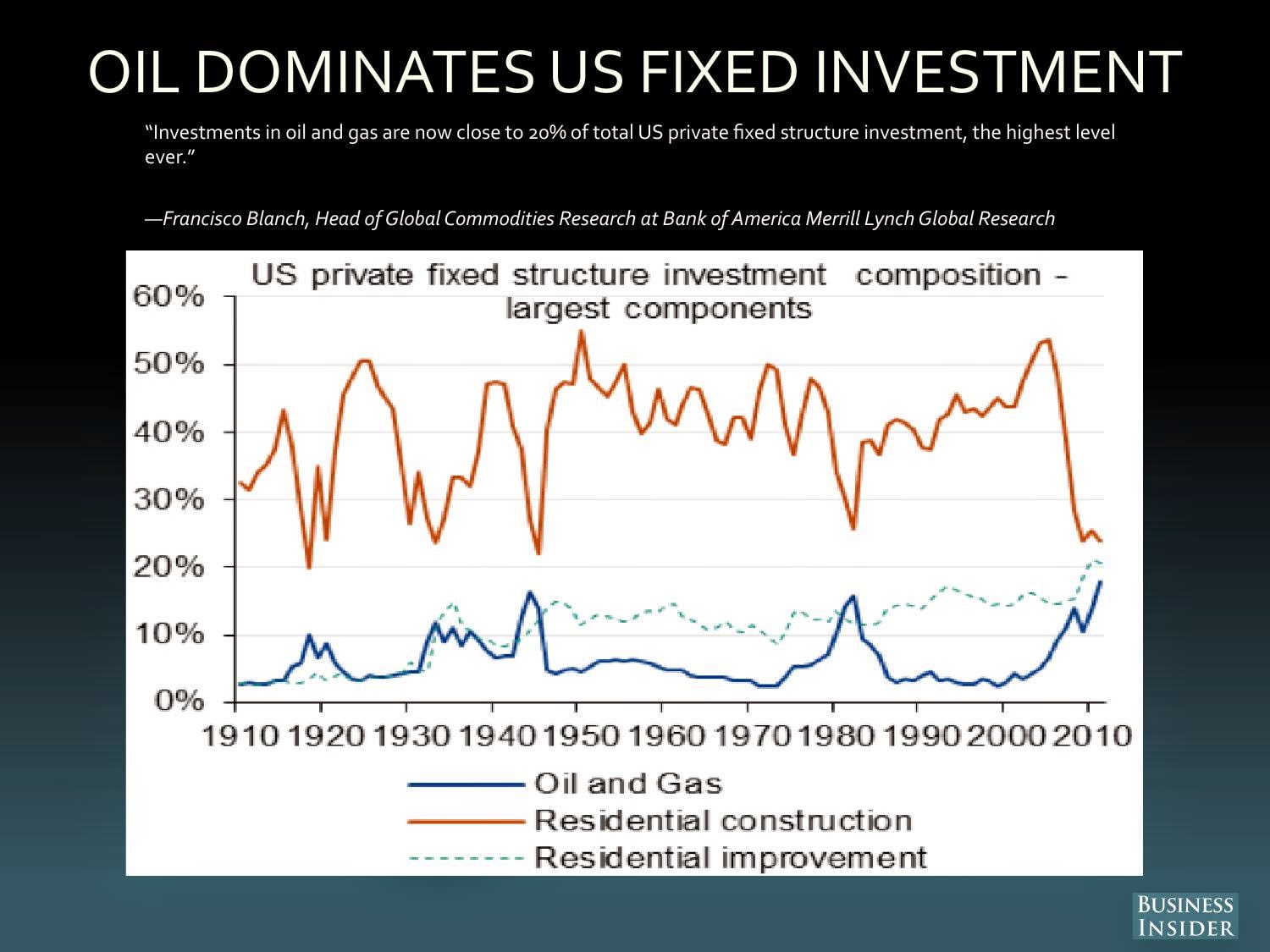
Another forward looking indicator is US residential construction investment which is slowing:


Finally, the collapse in oil prices is telling you that the global economy is stagnating and that inflation is not likely to be a concern in the short to medium term (lower inflation = economy not operating at full capacity):


The other reason the US economy will slow in the short-medium term is that a significant part of the US economic recovery has been driven by fixed capital investment in the oil and gas industry. With oil prices falling, we are likely to see less investment activity. It depends how much further oil prices fall, but WTI would need to fall below $80 before we start seeing projects suspended.


Of course falling oil prices are also beneficial to US consumers who will be paying less to fill up their cars. It is often remarked that a falling oil price is like a tax cut for consumers who will now have higher discretionary incomes. The falling oil price is a mixed bag for growth but inflation is definitely less of a problem in the short-term.

There are other macro risks including geopolitics and further strength in the USD, which would slow down the US recovery. Until those risk scenarios materialise, the US economy should continue to heal albeit at a slower pace. The Fed is unlikely to increase rates until wages begin to rise and inflation becomes a clear problem. Given the perception of a fragile recovery, the Fed will be reluctant to raise the Fed Funds Rate/IOER early. I do not see the Fed increasing interest rates in the first half of 2015 and are now less likely to hike rates in the second half of 2015.

To summarise:
  • Forward looking indicators are warning that the US economy's momentum is slowing along with the global economy
  • Inflation less of a concern given market expectations and falling oil prices
  • Deflationary forces will prevent the Fed from increasing interest rates in the first half of 2015


17 October 2014

Mea Culpa

"When the facts change, I change my mind. What do you do, sir?" - Unknown quote

Rebuilding the model

Part of the learning process is acknowledging the limitations of your understandings and when a better theory or model of the world is developed then one must reject any contradictory models or theories. I say this because a year ago you could have described my economics views as Austrian, with little tolerance for government intervention. Whether it be regulations, taxes or spending - the less the better.

That changed towards the end of 2013 after I learned that the Austrian model of banking and money is inaccurate when applied to the current monetary system (it may have been accurate decades ago). Further doubts arose as I learned more about cognitive bias and behavioural economics/finance. These realisations invalidated my economic view of the world and I began to question everything including: if free markets were really the best way to allocate resources? and does government have a role to play during recessions? But I first had to address how I came to be so wrong in the first place.

I looked at my economic education sources: Mises.org, ZeroHedge, Peter Schiff etc. What do they all have in common? All have a strong libertarian political bias and hence also share a pro-free market or Austrian economic view. I couldn't believe it, I had fallen for confirmation bias. My own libertarian political bias had guided me to embrace an economic school of thought which supported absolutely free markets with little room for government intervention. I knew that any cognitive bias distorts one's perception of reality and if I wanted to know how the economy really operates, I would need to research other economic theories and schools of thoughts objectively.

Like a phoenix rising from the ashes, a new model is born.

I started my post-Austrian economic journey when I discovered Modern Monetary Theory (MMT) and Money Realism (MR). At first their theories sounded heretical. They were saying things like the government can never default and that bank loans create bank deposits. Like any objective critical thinker, I learned more about it and found their monetary model to be a more accurate portrayal of the current monetary and banking system than any Austrian model.

Earlier this year, the Bank of England released a paper (highly recommended reading to understand money creation and QE) explaining the monetary system, which matched the model portrayed in MMT and MR. It also means that it punches holes in Austrian theory with conclusions such as:
  • Banks don't rely on deposits to create loans
  • Savings that are deposited in a bank do nothing for the economy. Hence savings deposited at a bank or what Keynes described as "liquid assets", results in less economic activity
  • A central bank conducting QE is not the same as the "money printing" in Zimbabwe or Weimar Germany
I still think the Austrians have a lot right about high levels of government intervention harming the economy and their theory of malinvestment has some merit. But their monetary model (loanable funds model) needs to be discarded to reflect the current reality. In response to these claims, Austrians retort that they describe the real economy and not the fiat/nominal/accounting economy. This may be true, but at least acknowledge that the loanable funds model (people save and then banks lend those savings out) embedded in Austrian Capital Theory is utterly wrong.

So what are my general beliefs and views now? After being intellectually burned on Austrian theory, I've become a strong proponent of objectivity and observation rather than developing a theory and then imposing it on the world. In Nassim Taleb's book Antifragile, he discusses this thought process and classifies it as phenomenology. Simply put: don't worry about the theory, just know what works.

Much of mainstream economics is influenced by political bias and therefore any accurate economic school of thought must be apolitical. Given this premise, I was forced to reject MMT because they are tainted by a strong left-wing political ideology which favours pervasive government intervention. This leaves MR which explicitly states its focus on the "operational realities of the current monetary system". Political decisions are left to others and have no place in MR. As nerdy as this sounds, I fell in love with this principle.

You can learn about Money Realism at pragcap.com run by the wonderful and erudite Cullen Roche.

What are my current economic thoughts?

I think everything that MR claims is true when compared to all other economic schools of thought. Cullen does a fantastic job of comparing the other economic schools here and here.

One of the important tenets of MR is that we are all irrational and thus, markets are not as efficient as we believe (you probably already knew that). This does not imply free market capitalism should be rejected. It just means pure capitalism is not the ideal outcome for the economy.

Government intervention can be a net benefit to the economy in a recession if done correctly. There is a fine line between allowing an unsustainable boom or bubble to deflate and preventing a potential depression. Policy makers must not prop up inefficient businesses if they are the by-product of poor decisions by investors (similar to the Austrian malinvestment theory).

I also place a lot of value on cognitive bias and behavioural economics/finance. It explains everything from booms/busts (herd mentality and loss aversion) to people claiming the data is manipulated to show no inflation (confirmation bias and just batshit crazy).

I also have incorporated the main idea of Antifragile by Nassim Taleb, describing things that become stronger (antifragile) not weaker (fragile) after being temporarily exposed to a stressor.

Cannot recommend this book highly enough!

An economy is just the aggregate of people's spending decisions and because of behavioural biases like overconfidence and the herd mentality, excesses can accumulate in the system. Without the full impact of a recession, risk taking will become irrational as investors expect fiscal and monetary stimulus to limit their losses (moral hazard). This is similar to Minsky's Financial Instability Hypothesis which states stability creates instability. In layman's terms, the more stable the economy, the more risk taking which results in future instability. Again you can see the influences of behavioural economics with overconfidence etc.

This is the main reason I strongly believe a recession should be allowed to run its course. After a recession, the system becomes stronger as the weakest businesses are liquidated and the factors of production that were previously used inefficiently are now reallocated to the strongest and more efficient businesses. The government can support unemployed people through welfare and can stimulate economic activity but cutting taxes and allowing the deficit to increase. These measures must be taken ONLY after the unsustainable excesses and malinvestments of the boom are liquidated.

What lies ahead...

Now that I have a better understanding of the reality of the banking system, it's time to update my predictions. My own view is that all developed economies are sinking into Japanese style debt deflation. The conventional monetary policy is that lowering interest rates encourages more borrowing which is then spent on investment by businesses and consumption by households. Implicit in this theory is that we can reduce the severity of recessions and the economy will grow forever. Is that possible? Can we just always lower interest rates and the economy keeps on chugging along to new heights? Remember that old phrase when someone tries to convince you that some form of government intervention makes everyone a winner, there's no free lunch in economics. There are other confounding factors such as demographic trends, inequality and technological progress fuelling the deflationary trend which I will discuss in future posts.

But that's it for now. In the next post I will be reviewing my past predictions and updating my forecasts for the future using my current and more accurate understanding of economics and finance.

20 June 2013

Apocalypse Now


This blog update will focus on the main risks I see on the horizon for the Australian economy.

I warn you that I haven’t really bothered to format and edit it, so I apologise in advance if it’s difficult to read.

I will start off with the simple premise: All booms come to an end. The Japanese boom of 80s and 90s, the 1994 Tequila crisis, 1997 Asian financial crisis, the 2001 tech boom, the 2007 US housing boom and in 2013 the China boom. All of these eras culminated in major increases in asset and commodity prices, usually accompanied by debt, until central banks removed the punchbowl through contractionary monetary policy.

A Bear in a China Shop

Australia is a major beneficiary of the Chinese boom by supplying the energy and minerals needed to fuel China’s economic activity. China’s rapid industrialisation has resulted in many malinvestments, which will be liquidated as capital flows dry up. The excess capacity and debt accumulated during the boom will haunt the economy for years to come. It is generally accepted that the bigger the boom, the bigger the bust.

The Chinese banking system has also been dysfunctional in recent weeks with SHIBOR spiking as banks face liquidity problems. This is a microcosm of the systemic imbalances and instability plaguing China. It’s only a matter of time before a tiny bump in the road crashes the economy.

Falling iron ore, copper and coal prices will be the harbinger heralding the beginning of the end for the Australian mining sector. The government will stimulate as usual but just like in 2009, it was the currency devaluation and the stimulus from China that did most of the heavy lifting.

Big in Japan

Japan is rolling the dice with its audacious monetary policy. The volatility seen in JGBs will have consequences for institutions that are sensitive to high volatility investments. I know this from experience that banks look for positive carry and low volatility assets. JGBs are likely to sell-off given higher future prices from today’s QE. (Funny how a few years ago if you said QE causes inflation, you were ridiculed). Like all government actions, the unintended consequences will be largely unknown. However, it is certain to cause massive market disruption as long-held beliefs are shattered.

If JGB yields rise significantly then the consequence for the Japanese government’s budget is dire. This is what Kyle Bass refers to as the Keynesian Endgame which is when the interest cost of servicing the debt rises in a non-linear way which means simply increasing taxes will be ineffective. Then it will be Japan’s turn to experience its own Greek moment, however there’s no Troika to bailout Japan. Inevitably, the social fabric of Japan will be torn and the historical outcome of mass social unrest is the rise of extreme politics (See Greece and Golden Dawn, see Weimar Germany and the Nazi Party) followed by conflict and war.

Everybody was Kung Fu Fighting

Chinese and Japanese economic risks are not the only factors but also geopolitical risk stemming from conflict over the Senkaku Islands. Both sides are irrationally attached to these islands and are willing to go to war to seize control. If there were a conflict, it would first result in economic sanctions between the warring nations followed by armed conflict unless the UN intervenes to negotiate a cease fire. The impact on financial markets would be huge with the yen likely to rally substantially in risk-off flows bringing an abrupt end to Abenomics. Equities are guaranteed to sell-off. It would be hard to imagine any rallying (maybe domestic producers) but with so much of the global supply chain located in Asia, most multinational companies will face major disruptions.

Up the Creek

In addition to foreign risks, domestic risks are a slow grind lower in property prices as the boom over the last few decades ends, and the factoid of property prices rising forever is rejected.

There are also known unknowns (as Donald Rumsfeld likes to say), which include terrorism, global health pandemic (watch the movie Contagion), natural disasters, wars, government policies (QE, protectionist trade and capital policies). Individually they are unlikely to occur but collectively one of these happens every 3 years (Swine/Bird flu, Fukushima, QE, Boston bombings).

Of course it’s not all doom and gloom. There are a few unlikely upside risks which include: New technological development that makes Australia a world leader, major resource discovery, massive Chinese economic stimulus. This is the Bon Jovi equivalent of living on a prayer. 

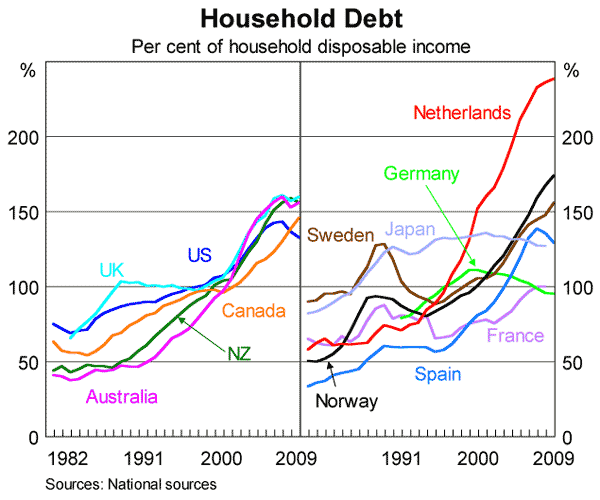
The fundamental problem with the Australian economy, along with most advanced economies, is the heavy debt burden which must be alleviated through deleveraging or defaults. Just think about it like this: It’s 2009 and interest rates are at record lows. John decides to buy a $500k house to take advantage of the low interest rates. This means upwards of $400k in new money (expanding the money supply) has entered the economy courtesy of fractional reserve banking when the mortgage is originated. It’s now 2013 and interest rates are coming down. Joe can now repay his loan faster (contracting the money supply) or use the money saved in interest payments for other consumption purposes. The key point is unless new loans are being originated, falling interest rates have a diminishing effect on monetary expansion given it was only 4 years ago that people took out massive loans which they are still repaying.

This causes the economy to deleverage which means businesses go bust, unemployment rises and prices fall. All of these outcomes force the RBA to cut interest rates to ignite another cycle of inflationary monetary expansion and the illusion of economic growth. Keep in mind we haven’t had a technical recession (two consecutive quarters of negative economic growth) in over two decades. We are due for a recession because markets and economies NEVER move up in a straight line. There are dips along the way and the longer we postpone the recession, the deeper it will be.

Breaking Windows Will Boost GDP

Already we have seen the fallacy of stimulus spending. The moment we try to pay back the debt, jobs are destroyed through contractionary fiscal policy (less spending or higher taxes). This means when the next recession comes, the government will go deeper into debt. On average, recessions occur every 7-10 years which means we should expect an Australian recession between 2015-2018 using historical data. However, given the inability of the RBA to raise rates substantially before the economy begins to deleverage (as seen post 2009), the business cycle is contracting in duration. So much so that I am sure a recession will come before 2016. Obviously the government will try to stimulate and rates will be cut closer and closer to zero.

As a personal anecdote, I know financially unsophisticated boomers who bought their homes a few decades ago that are now cashing out their investment properties and living off term-deposits. This is exactly why interest rates continue to fall. The economy is trying to delevereage which means property prices and other assets will decline while the RBA tries to push prices back up to avert pessimism overcoming the property market.

There is a theory that claims the closer rates go to zero, the more risk averse investors become and the more they invest in government bonds and other relatively low risk investments. This theory is only true for advanced economies with an ageing population such as Australia.

Forecast: Cloudy With a Chance of Thunder Storms

My predictions: base case rates go lower in Australia to 2% and in combination with the lower AUD (70c-80c) causes the economy to re-leverage. Worst case scenario is an implosion in Asia due to any of the factors mentioned above, will cause rates to go to zero in Australia and the AUD to go sub 50c as commodity prices collapse and the high unemployment prevents credit growth from occurring.  It’s difficult to see any bullish scenario simply because “we’ve been there and done that” for a few years now.

The obvious plays for a long-term investor in a falling interest rate environment are defensive stocks and high dividend yield stocks. But a safer option would be corporate bonds that would still offer a decent yield while central bank rates approach zero. If you want to trade it then the obvious trade is shorting AUD against a reserve currency like the USD or EUR. Or a safer currency trade would be short AUD against another commodity currency less affected by China such as the NOK (Norway). Other trades include shorting high cost iron ore miners which will see their businesses go under overnight as commodity prices plunge.

Anyway I hate predicting anything financial or economic more than one year out because there are so many variables that could throw a spanner in the works. It will be amusing to see how it plays out compared to the aforementioned predictions.

Summary of Predictions

  • Australian recession before 2016
  • Interest rates to go to 2% and AUD/USD 0.80-0.70 base case with rates going to zero and AUD/USD below 0.50 worst case (financial/political crisis in Asia or global macro risk mentioned above)
  • Corporate bonds to outperform, short AUD and iron ore miners trades to also outperform


“I don’t get paid to be an optimist or a pessimist. I get paid to be a realist.”


06 March 2013

The Keynesian Endgame

I absolutely despise the Keynesian school of economic thought. The Keynesians worship three gods: demand, jobs and inflation. All of which have given us the world that we live in today. A world mired in debt due to government policies designed to stimulate demand and “create” jobs. The parabolic rise in debt across the economy since the 1970s cannot go on forever. It should be obvious to anyone that anything rising at an exponential rate will eventually hit a constraint that will reverse the trend.

The constraint to hit parabolic debt is deflation. Deflation is a contraction in the money supply. Most people will say deflation is falling prices but changes in the price level are a consequence of the supply of money relative to the goods and services produced in an economy.

During the boom times, economic activity is rising and money is being borrowed. Fractional reserve banking creates a vicious cycle of rising asset prices, followed by rising levels of equity relative to debt, further leading to more money borrowed which is then used to bid asset prices higher. Eventually, this cycle is reversed as central banks increase interest rates to a point where asset prices stop rising and debts are repaid or defaulted upon. What follows is a cycle of falling asset prices and as debt is repaid, a contraction of the money supply (deflation). Central banks (CB) see this as a major problem which is solved by slashing interest rates to get people borrowing and see rising asset prices. Before you say this is crazy talk, Bernanke has explicitly said the Federal Reserve has propped up not only the housing market but the stock market in what he calls “the wealth effect”. Every major central bank has this secret third mandate of propping up both housing and the stock market (the first two are inflation and employment). It was only a few years ago that no central banker would admit to having this secret third mandate.

This model of monetary policy has worked “fine” until the demand for new borrowing evaporates and despite interest rates being cut, the economy does not return to the debt fuelled inflation boom. This is my theory of the economic cycle, which closely resembles Austrian Business Cycle Theory and it may even be the same. Eventually debt becomes too high and no matter what the CB does the deleveraging process continues.


Either the government slowly tries to reflate the economy (Japan last 20 years) or they go nuclear with continuous debt monetisation (US Federal Reserve) or threats to go all in (Bank of Japan in recent months) with seemingly outlandish policy options such as negative interest rates, nominal GDP targeting and monetising private sector assets (corporate bonds, equities etc.).

With central banks increasing underestimating the risk of rampant inflation as a consequence of their unconventional monetary policy (debt and asset monetisation), the inevitable conclusion is hyperinflation. CBs have made it clear they will not tolerate deflation. Nothing is stopping them from expanding the money supply by trillions as long as they fear the threat of deflation. This is exactly why asset prices will skyrocket and the only thing likely to destroy confidence and asset prices are an exogenous shock (natural disasters, political risks, terrorist attacks, wars, social unrest etc.).

The consequence is rising interest rates as investors realise the CBs have poured gasoline on the fire through their reckless monetary inflation. Bond markets will collapse and anyone holding long duration debt will be burned (insurance companies, banks and pension/superannuation funds). Government borrowing costs will rocket higher as rising interest rates will mean any debt that is rolled over will rollover at higher interest rates. This is very similar to the sub-prime mortgages crisis when low teaser interest rates made the mortgage affordable until the interest rate reset to a much higher rate a few years later. This will result in the government slashing government expenditure in an attempt to service the debt and appease the bond vigilantes. The current European debt crisis is a glimpse of what we can expect when governments have to make tough decisions that are very politically unpopular.

The penultimate result of the chaos will be a deep recession as unemployment rises, causing social unrest (riots and protests) as governments struggle to deal with the problem (see Greece and Spain).
Central banks will be forced to increase interest rates but I guarantee they will be too slow to act or worse remain in denial and downplay the inflation risk as “transitory”. The UK has already experienced the effects of monetisation on consumer prices.


What’s worse is there are now calls in the UK to drop inflation targeting in favour of nominal GDP targeting. This essentially means if the nominal GDP target is 4%, inflation can be 3% which means real GDP is only 1%. Another combination is a target of 3%, real GDP of -2% and inflation of 5%. There are numerous permutations but it just shows how ridiculous nominal GDP targeting is.

What is the solution? Over the years I’ve realised it’s usually the politically unpopular decision that is the correct decision. The only way we can address the debt issues not only on the public balance sheet but also the private balance sheet is to embrace sound money and back currency with gold or at the very least some other commodity. This stops the limitless expansions of the money supply and links it to a steady growth rate. There will be pain initially as people realise of the features of a gold backed currency is an end to the continual debasement and the end of rising prices economy wide.  

This solution is unlikely to happen because firstly, the mainstream pundits support the current monetary system and secondly, moving to a gold backed currency will be politically unpopular as vested interests scream and shout in protest (banks will probably the most vocal opponents given their mortgages denominated in the old currency and because the new system limits their ability to lend).

It will usually take a crisis to change people’s perceptions but even then, there’s no guarantee that perceptions will change for the better. I will strongly support the minority that adopts the new system first because it will take the minority view becoming the majority view before we see real change for the better.

15 August 2012

Banks Feed Off Inflation


Firstly let’s define inflation. Today’s common usage refers to inflation as rising prices either caused by an increase in aggregate demand with aggregate supply remaining static (demand pull inflation) or a decrease in aggregate supply while aggregate demand remains constant (cost push inflation).

So if there are tax cuts and there is more demand for all goods, is this considered inflationary? Yes by modern definition there will be an increase in aggregate demand causing demand pull inflation.

But my own view of inflation/deflation is the same as the classical definition of inflation which is an expansion of the money supply. The symptom of inflation is rising prices, which is why over time the factoid equating inflation to rising prices exists.

When the central bank adjusts interest rates, this affects the money held in bank reserve accounts and in turn affects a bank’s ability to make loans and increase the money supply.


When banks originate loans the money supply expands since a 10% reserve requirement will lead to banks using a $100 deposit to create a $1000 loan. This means when borrowers repay loans, the money supply contracts and similarly if a borrow defaults, the money supply really contracts. However, banks will use buffers to protect themselves against a default by first making sure the borrower is credit worthy, then requiring a deposit to banks are not taking the full risk, finally collateral will be linked to the loan (e.g. the property will be collateral for the mortgage loan).

As the money supply expands (inflation), asset prices rise since there is now more money chasing the same amount of goods. This in turn increases the demand for loans since people see asset prices rising and believe the economy is growing and additionally collateral value increases allowing potential borrowers to increase the leverage on their loan. Loan serviceability is another important factor when banks assess a potential borrower. Since all prices are increasing, including wages, pretty much all the factors a bank will look at to originate a loan improve in favour of the borrower.

This is the inflationary cycle that causes borrowing to lead to higher asset prices and then more borrowing. The central bank then tries to control this by increasing interest rates which should decrease the demand for new loans. However, there is a time delay in the effect and because the bulk of loans are long-term in nature (longer than a year) the economy doesn’t feel the full effect of a string of interest rate rises until a few years into the future. Eventually the economy begins to contract after a string of interest rate rises result in a fall in borrowing and then it is up to the central bank to re-start the game by slashing interest rates to begin a new cycle of borrowing and rising asset prices. This is how the business cycle works and is why under the current system any deflation is considered bad because if the central banks leaves the economy to contract and allow deflation to take hold, it will continue unabated until prices are so low that demand for loans increases. This could lead to a substantial contraction in the money supply and prices falling more than 10% in a single year.

The problem with this system is that banks depend on inflation the resulting loan origination to increase and maintain their current profits. If there is deflation, people demand less loans and repay their loans faster to reduce debt burdens. This causes a huge contraction in bank profits and when the economy really contracts, collateral values plunge as a vicious cycle of loan defaults and collateral devaluation takes place. One only has to look at what happens when a country has a bubble economy to see this scenario play out. Japan in the early 1990s, the US in 2008 and soon Australia will have its day of debt deflation.

Australia has hitched its wagon to the Chinese growth engine and Asia in general, which is where I fear the economic shock is likely to manifest itself. In many financial and economic crises we see banks come under severe stress and in many cases collapse as their reserves vanish via asset impairment, exposing their leveraged business model. Governments then become involved via bailouts and hence taxpayers are now proud owners of zombie banks.


This is exactly why substantial deflation (>2% deflation) will never be allowed to occur and why eventually rates will go to zero. Banks will not survive unless they dramatically increase their reserves, which I do not foresee happening during extreme economic uncertainty. The government will nationalise banks claiming that the economy will implode if nothing is done.

These are dire predictions and I am sure the majority will disagree with this forecast but is there really another outcome when the current solution to any downturn is to spur spending and borrowing via lower interest rates?