I absolutely despise the Keynesian school of economic thought. The Keynesians worship three gods: demand, jobs and inflation. All of which have given us the world that we live in today. A world mired in debt due to government policies designed to stimulate demand and “create” jobs. The parabolic rise in debt across the economy since the 1970s cannot go on forever. It should be obvious to anyone that anything rising at an exponential rate will eventually hit a constraint that will reverse the trend.
The constraint to hit parabolic debt is deflation. Deflation is a contraction in the money supply. Most people will say deflation is falling prices but changes in the price level are a consequence of the supply of money relative to the goods and services produced in an economy.
During the boom times, economic activity is rising and money is being borrowed. Fractional reserve banking creates a vicious cycle of rising asset prices, followed by rising levels of equity relative to debt, further leading to more money borrowed which is then used to bid asset prices higher. Eventually, this cycle is reversed as central banks increase interest rates to a point where asset prices stop rising and debts are repaid or defaulted upon. What follows is a cycle of falling asset prices and as debt is repaid, a contraction of the money supply (deflation). Central banks (CB) see this as a major problem which is solved by slashing interest rates to get people borrowing and see rising asset prices. Before you say this is crazy talk, Bernanke has explicitly said the Federal Reserve has propped up not only the housing market but the stock market in what he calls “the wealth effect”. Every major central bank has this secret third mandate of propping up both housing and the stock market (the first two are inflation and employment). It was only a few years ago that no central banker would admit to having this secret third mandate.
This model of monetary policy has worked “fine” until the demand for new borrowing evaporates and despite interest rates being cut, the economy does not return to the debt fuelled inflation boom. This is my theory of the economic cycle, which closely resembles Austrian Business Cycle Theory and it may even be the same. Eventually debt becomes too high and no matter what the CB does the deleveraging process continues.
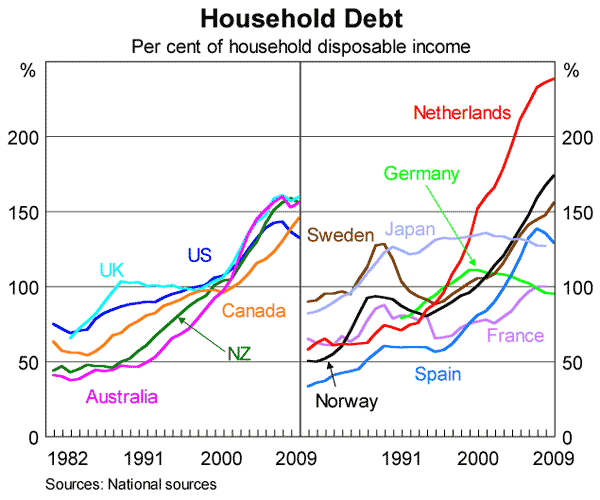
Either the government slowly tries to reflate the economy
(Japan last 20 years) or they go nuclear with continuous debt monetisation (US
Federal Reserve) or threats to go all in (Bank of Japan in recent months) with
seemingly outlandish policy options such as negative interest rates, nominal
GDP targeting and monetising private sector assets (corporate bonds, equities
etc.).
With central banks increasing underestimating the risk of
rampant inflation as a consequence of their unconventional monetary policy
(debt and asset monetisation), the inevitable conclusion is hyperinflation. CBs
have made it clear they will not tolerate deflation. Nothing is stopping them
from expanding the money supply by trillions as long as they fear the threat of
deflation. This is exactly why asset prices will skyrocket and the only thing
likely to destroy confidence and asset prices are an exogenous shock (natural
disasters, political risks, terrorist attacks, wars, social unrest etc.).
The consequence is rising interest rates as investors
realise the CBs have poured gasoline on the fire through their reckless
monetary inflation. Bond markets will collapse and anyone holding long duration
debt will be burned (insurance companies, banks and pension/superannuation
funds). Government borrowing costs will rocket higher as rising interest rates
will mean any debt that is rolled over will rollover at higher interest rates.
This is very similar to the sub-prime mortgages crisis when low teaser interest
rates made the mortgage affordable until the interest rate reset to a much
higher rate a few years later. This will result in the government slashing
government expenditure in an attempt to service the debt and appease the bond
vigilantes. The current European debt crisis is a glimpse of what we can expect
when governments have to make tough decisions that are very politically
unpopular.
The penultimate result of the chaos will be a deep recession
as unemployment rises, causing social unrest (riots and protests) as
governments struggle to deal with the problem (see Greece and Spain).
Central banks will be forced to increase interest rates but
I guarantee they will be too slow to act or worse remain in denial and downplay
the inflation risk as “transitory”. The UK has already experienced the effects
of monetisation on consumer prices.


What’s worse is there are now calls in the UK to drop inflation targeting in favour of nominal GDP targeting. This essentially means if the nominal GDP target is 4%, inflation can be 3% which means real GDP is only 1%. Another combination is a target of 3%, real GDP of -2% and inflation of 5%. There are numerous permutations but it just shows how ridiculous nominal GDP targeting is.
What is the solution? Over the years I’ve realised it’s
usually the politically unpopular decision that is the correct decision. The
only way we can address the debt issues not only on the public balance sheet
but also the private balance sheet is to embrace sound money and back currency
with gold or at the very least some other commodity. This stops the limitless expansions
of the money supply and links it to a steady growth rate. There will be pain
initially as people realise of the features of a gold backed currency is an end
to the continual debasement and the end of rising prices economy wide.
This solution is unlikely to happen because firstly, the
mainstream pundits support the current monetary system and secondly, moving to
a gold backed currency will be politically unpopular as vested interests scream
and shout in protest (banks will probably the most vocal opponents given their
mortgages denominated in the old currency and because the new system limits
their ability to lend).
It will usually take a crisis to change people’s perceptions
but even then, there’s no guarantee that perceptions will change for the
better. I will strongly support the minority that adopts the new system first
because it will take the minority view becoming the majority view before we see
real change for the better.